

Comparing collagen supplements often leads to the same question: why does marine collagen cost more than bovine collagen, and does the higher price actually mean better results?
This Marine vs bovine collagen comparison looks at the differences that matter most — collagen type, absorption, skin and joint support, safety, taste, and cost. The goal is simple: help you choose based on evidence and your own needs, not marketing claims. Collagen supplements provide nutritional support; they are not treatments for medical conditions.
Quick Answer
Marine collagen comes mainly from fish skin and scales and is predominantly Type I collagen. It typically costs more and is a practical choice for pescatarians or people who avoid bovine ingredients. Its Type I content, however, does not automatically make it better for skin.
Bovine collagen comes mainly from cattle hides and connective tissue and typically contains Types I and III collagen. It is more widely available and generally less expensive, making it a practical choice for people without beef-related dietary restrictions.
A few points worth keeping in mind before you choose either one:
- Claims that marine collagen “absorbs better” don’t automatically mean it produces better results.
- Neither source is a universal winner — the right pick depends on your goals, diet, allergies, and budget.
- Product quality, dosage, formulation, hydrolysis, and third-party testing often matter more than the animal source itself.
- How consistently you use a supplement also shapes the real-world experience — but that’s one factor among several, not a reason to overlook source-related differences like allergies or diet.
| Factor | Marine Collagen | Bovine Collagen |
|---|---|---|
| Source | Fish skin, scales, processing byproducts | Cattle hides, connective tissue |
| Typical Collagen Types | Predominantly Type I | Type I and Type III |
| Common Reasons for Choosing | Avoiding beef, pescatarian diets | Affordability, wide availability |
| Allergy Considerations | Fish allergens | Beef-related sensitivities (less common) |
| Dietary Compatibility | Pescatarian-friendly, not vegan | Halal/kosher available with certification, not vegan |
| Taste/Odor | Can have a mild fishy note | Generally more neutral |
| Typical Cost | Higher per serving | Lower per serving |
| Quality Considerations | Traceability, contaminant testing | Sourcing transparency, testing |
| Best Fit | Fish-friendly diets, beef avoidance | General use, budget-conscious buyers |
Marine vs Bovine Collagen: Source and Collagen Types
Marine collagen comes from fish, while bovine collagen comes from cattle. That difference also affects the collagen types typically found in each supplement — an important distinction when comparing the two.
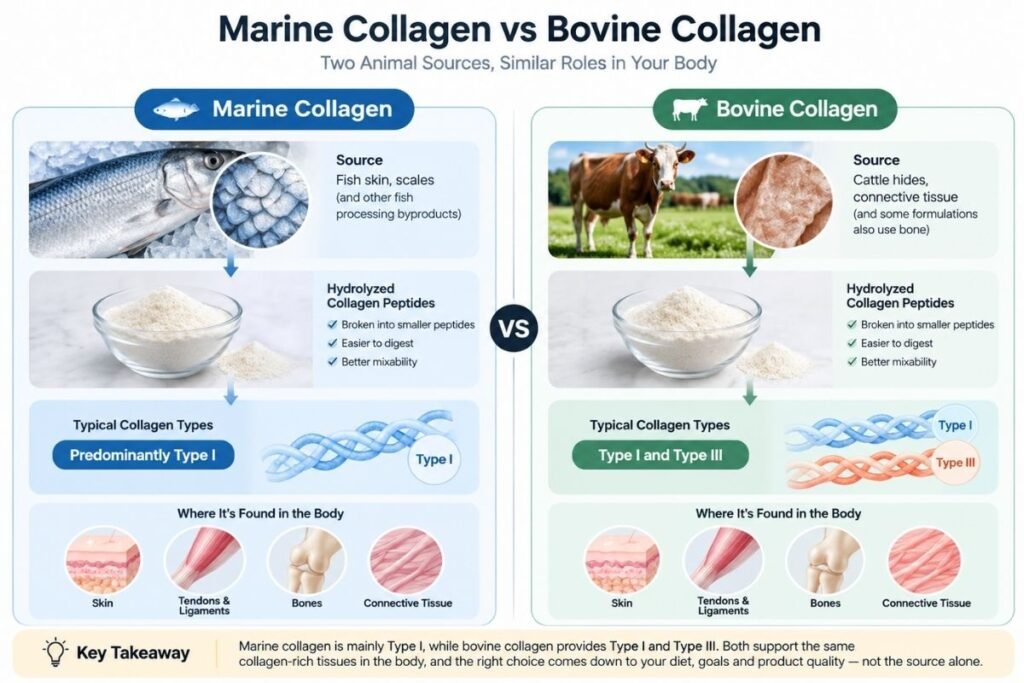
Marine collagen is extracted primarily from fish skin, scales, and, in some formulations, other fish processing byproducts. Marine collagen can make use of fish-processing byproducts, although that alone does not make every marine collagen product more sustainable — actual environmental impact still depends on the fish source, how it was caught or farmed, processing methods, and transportation. Marine collagen is predominantly Type I collagen, the most abundant collagen type in the human body.
What Is Bovine Collagen?
Bovine collagen typically comes from cattle hides and connective tissues, and some formulations also use bone. It commonly contains both Type I and Type III collagen, which is one reason it’s often marketed for a broader range of uses than marine collagen.
It’s worth noting that exact collagen composition can vary between products, depending on the specific source material and how it’s processed. Two “bovine collagen” products aren’t guaranteed to be identical.
Type I vs Type III Collagen
Type I collagen is found throughout skin, tendons, bones, and connective tissue — it’s the most common collagen type in the body. Type III collagen is often found alongside Type I, particularly in skin and blood vessels, and plays a supporting structural role.
A common beginner assumption is that a more expensive marine collagen product must contain “better” or more comprehensive collagen simply because of its price. In reality, animal source doesn’t determine collagen type on its own, collagen type doesn’t guarantee a specific health outcome, and oral collagen doesn’t travel selectively to one part of the body once it’s digested. Those three points are worth remembering throughout the rest of this comparison.
Does Marine Collagen Absorb Better Than Bovine Collagen?
“Better absorption” is one of the most common reasons given for choosing marine collagen — and often for paying more for it. But absorption depends on more than whether the collagen comes from fish or cattle. Peptide size, hydrolysis, and product formulation all matter.
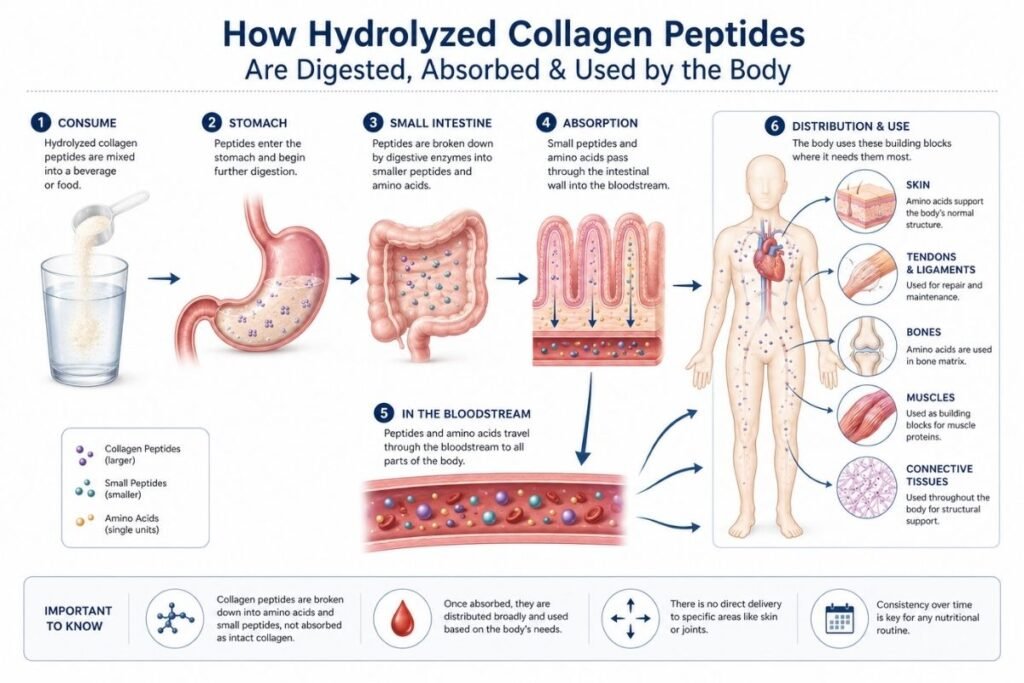
How Hydrolyzed Collagen Peptides Are Absorbed
Most collagen supplements — marine or bovine — use hydrolyzed collagen, meaning the collagen protein has already been broken down into smaller peptides before you consume it. This process, called hydrolysis, is done specifically to make the collagen easier for your digestive system to break down further and absorb.
Once consumed, these peptides are digested into smaller peptides and free amino acids, absorbed through the intestine, and released into circulation, where the body can use the resulting amino acids for various purposes — not necessarily the ones printed on the supplement label.
Does Marine Collagen Have Smaller Peptides?
Some marine collagen products are marketed around the idea of smaller peptide size, which is sometimes linked to faster or more efficient absorption. This is biologically plausible in a general sense, but it doesn’t automatically apply to every marine collagen product on the market. Peptide size and molecular weight depend heavily on how a specific product is processed, not just on whether the source is fish or cattle. A poorly processed marine collagen product won’t automatically out-absorb a well-processed bovine one.
Better Absorption vs Better Results
Here’s the distinction that gets lost in marketing copy: absorption, bioavailability, and clinical outcomes are three different things. A peptide can be absorbed efficiently without that translating into measurably better skin hydration, joint comfort, or any other outcome. Direct human comparisons remain limited, and the pharmacokinetic research available does not establish a simple rule that marine collagen is universally better absorbed than bovine collagen.
One 2024 randomized human crossover study compared collagen hydrolysates from fish, pork, and cattle sources directly, and found that all three sources produced broadly comparable plasma concentrations of collagen-related metabolites, including similarly comparable absorption of free hydroxyproline. The study authors themselves noted that larger studies are still needed before drawing firm conclusions — but the available head-to-head data does not support the idea that marine collagen has a clear absorption advantage over bovine collagen.
If you see a specific number attached to an absorption claim — something like “1.5x better absorption” — it’s reasonable to treat that figure cautiously unless it’s backed by independent, transparent research rather than a brand’s own internal testing.
To put it concretely: imagine two collagen products, one marine and one bovine, both using well-hydrolyzed peptides of similar molecular weight. On paper, there’s little reason to expect a meaningful absorption difference between them based on species alone. The processing matters more than the label.
Marine vs Bovine Collagen for Skin, Hair, and Joints
Before breaking down each goal, it’s useful to understand what actually happens after you swallow a collagen supplement. It gets digested into peptides and amino acids like other dietary protein — it isn’t delivered intact to your face, joints, or scalp. Any benefit comes from how your body uses those amino acids, not from collagen being “routed” to a specific tissue.
For Skin Hydration and Elasticity
Type I collagen is abundant in skin, which is part of why marine collagen — being predominantly Type I — is so heavily marketed for beauty and anti-aging purposes. Bovine collagen also commonly supplies Type I collagen, so it isn’t automatically at a disadvantage here.
Some research on oral collagen supplementation has shown modest improvements in skin hydration and elasticity over consistent, longer-term use. However, it’s a mistake to assume marine collagen produces superior skin results simply because it’s predominantly Type I — bovine collagen contains Type I as well, and the available evidence doesn’t clearly separate the two sources on skin outcomes specifically.
Results are promising, but confidence should remain measured. Trial formulations vary considerably, and a recent meta-analysis found that when studies were separated by funding source, industry-funded trials tended to report significant skin benefits, while independently funded trials generally did not find the same effect. That doesn’t mean collagen doesn’t work for skin — it means the strength of the evidence is less settled than marketing materials often suggest. Realistic expectations matter here: any visible changes tend to be gradual, not immediate, and results vary between individuals.
For Hair and Nails
Collagen is frequently marketed as a solution for stronger hair and nails, largely because collagen-related amino acids support the proteins that make up hair and nails. That said, the evidence supporting collagen supplementation specifically for hair and nail outcomes is less established than for skin.
It’s worth being cautious about claims promising faster hair growth, prevention of hair loss, or treatment of brittle nails — collagen supplementation isn’t well-supported for these specific outcomes, and adequate overall nutrition and protein intake generally matter more for hair and nail health than any single supplement.
For Joints, Connective Tissue, and Active Lifestyles
Several systematic reviews and meta-analyses report improvements in some joint pain and function outcomes with collagen supplementation, particularly with consistent daily use over extended periods — though formulations, study populations, and overall study quality vary considerably between trials.
Bovine products are often marketed for broader connective-tissue support because they commonly contain both Type I and Type III collagen, but that marketing distinction shouldn’t be confused with evidence that bovine collagen actually produces better joint outcomes than marine collagen — the research connecting specific collagen types to joint outcomes is still developing. It’s also worth noting that Type II collagen, which is particularly associated with cartilage, is a separate consideration from the basic marine-vs-bovine Type I/III comparison and is typically found in different supplement formulations altogether.
For active adults, collagen can be a useful addition to overall protein intake, but it’s best understood as a specialized protein source rather than a guaranteed recovery supplement or a replacement for complete dietary protein.
For Gut Health
Collagen has become a popular talking point in gut-health discussions, often based on the biological rationale that amino acids like glycine may support the gut lining. This is a plausible area of interest, but current human clinical evidence remains limited compared to the claims circulating online.
It’s important to distinguish emerging research from established benefits here. Claims that collagen “heals leaky gut” or “repairs the gut” go beyond what the current evidence supports and edge into disease-treatment language that a nutritional supplement shouldn’t be making.
Which Collagen Fits Your Goal?
| Goal | Marine Relevance | Bovine Relevance | Evidence Strength | Important Caveat |
|---|---|---|---|---|
| Skin hydration/elasticity | High (Type I) | High (Type I) | Moderate | Source alone doesn’t determine outcome |
| Hair/nails | Moderate | Moderate | Limited | Avoid growth or treatment claims |
| Joint/connective tissue support | Moderate | Moderate-High (Type I + III) | Moderate | Type II collagen is a separate category |
| Active lifestyle | Moderate | Moderate | Limited-Moderate | Not a recovery guarantee |
| Gut-health interest | Low-Moderate | Low-Moderate | Early/emerging | Avoid “heals/repairs” claims |
One shortcut worth correcting: it’s common for people to assume marine collagen is “for beauty” while bovine collagen is “for everything else.” That oversimplification doesn’t hold up well against the actual overlap in collagen types and evidence between the two sources.
Safety, Allergies, and Dietary Considerations
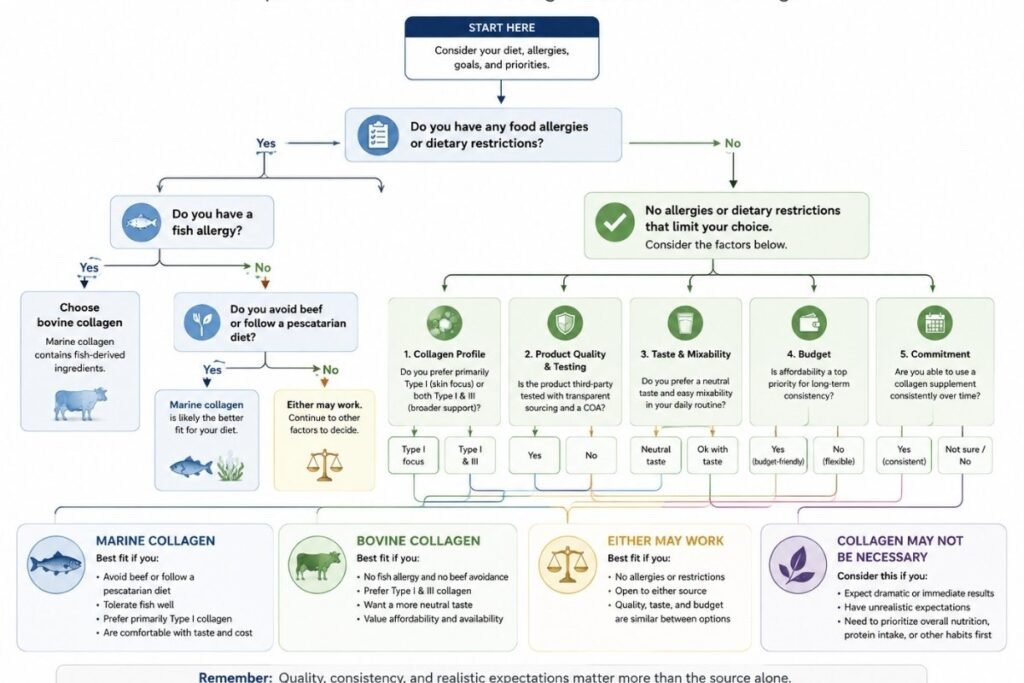
Marine collagen contains fish-derived ingredients, while bovine collagen comes from cattle, so food allergies, pescatarian diets, beef avoidance, and religious dietary requirements all need to be considered before choosing a product.
Fish Allergies and Marine Collagen
If you have a fish allergy, marine collagen is generally something to avoid or discuss with a healthcare provider first. It’s worth distinguishing fish-derived collagen from shellfish-derived ingredients, since these are different allergen categories — a shellfish allergy doesn’t necessarily rule out fish-derived collagen, and vice versa. Regardless, always check the actual allergen statement on the product rather than assuming based on the word “marine.”
Heavy Metals and Contaminant Concerns
Marine-sourced ingredients, including fish-derived collagen, are sometimes associated with concerns about mercury and other heavy metals or environmental contaminants, since fish can accumulate these depending on their environment. That said, marine origin doesn’t automatically mean a product is contaminated, and a “wild-caught” label on its own doesn’t guarantee purity either. This is exactly where third-party contaminant testing becomes relevant — a topic covered further in the buying-guide section below.
Bovine sourcing has its own contamination considerations related to farming practices and processing, so it would be inaccurate to assume bovine collagen is inherently cleaner or safer than marine collagen. Neither source gets an automatic pass on safety — testing and transparency matter for both.
Pescatarian, Halal, Kosher, and Beef-Free Diets
Marine collagen is generally compatible with pescatarian diets, while bovine collagen is not. For halal or kosher requirements, it’s important to verify actual certification on the product rather than assuming compatibility just because the source is fish or cattle. And it’s worth stating plainly: neither marine nor bovine collagen is vegan, since both are animal-derived. If a plant-based option is what you’re after, it’s worth reading a dedicated breakdown of vegan collagen-building alternatives instead.
There are also situations where it’s reasonable to check in with a healthcare provider before adding any collagen supplement — during pregnancy or breastfeeding, with significant food allergies, with relevant medical conditions, or if you’re taking medications that could interact with supplement ingredients.
Collagen Safety Check Before You Buy
- Do you have a known fish allergy?
- Have you reviewed the ingredient and allergen statement?
- Are you avoiding beef for dietary or religious reasons?
- Does the product fit a pescatarian diet, if relevant?
- Do you need verified halal or kosher certification?
- Do you have any relevant medical conditions to discuss with a provider first?
- Is the source and processing transparently disclosed?
A front-label claim like “wild-caught” or “grass-fed” can be reassuring, but it shouldn’t replace actually checking allergen statements, dietary certifications, and safety information — those claims describe how an animal was raised or caught, not whether the finished product has been tested for contaminants or verified for allergen content.
Taste, Mixability, and Cost
A powder that tastes unpleasant, clumps in your morning coffee, or becomes too expensive to keep buying is unlikely to fit comfortably into a long-term routine.
Does Marine Collagen Taste Fishy?
Some marine collagen products carry a mild fishy smell or aftertaste, though this varies quite a bit between brands and formulations. Flavor really is product-specific rather than something guaranteed by the source alone — a well-processed, well-flavored marine collagen can be nearly undetectable in a smoothie, while a lower-quality one may not be.
Which Collagen Mixes Better?
Bovine collagen is often formulated to be relatively neutral in taste and tends to dissolve easily in both hot and cold liquids. That said, lower-quality bovine products can still have a noticeable taste or clump when mixed, so quality and formulation matter more here than the source itself. Solubility can also vary by format — powders behave differently from capsules or ready-to-drink products, and some powders clump more in cold liquids than in hot ones.
In everyday use, people often find that a product’s mixability in their preferred drink — coffee, a smoothie, plain water, or oatmeal — matters just as much as its ingredient list, simply because a gritty or fishy-tasting product is much easier to stop using.
Is Marine Collagen Worth the Higher Price?
Marine collagen typically carries a price premium over bovine collagen, sometimes substantially. Package price alone can be misleading, though — it’s worth comparing cost per serving, the actual collagen amount per serving, and where useful, cost per gram, rather than just the price on the front of the container.
Whether that premium is worth it really depends on the individual reader’s priorities. If you have a dietary reason for choosing marine collagen — avoiding beef, following a pescatarian diet — the higher price may simply be a fixed cost of that choice. If dietary restrictions aren’t a factor, it’s worth honestly evaluating whether the marine premium is buying you anything beyond a different animal source, since the underlying evidence for meaningfully better outcomes remains limited.
Daily-Use Comparison
| Factor | Marine Collagen | Bovine Collagen |
|---|---|---|
| Taste | Can be mild to noticeably fishy | Generally more neutral |
| Odor | Possible fishy smell | Typically minimal |
| Hot beverage use | Generally works well | Generally works well |
| Cold beverage use | Can clump in lower-quality products | Can clump in lower-quality products |
| Formats | Powder, capsules, ready-to-drink | Powder, capsules, ready-to-drink |
| Convenience | Comparable across formats | Comparable across formats |
| Typical price | Higher | Lower |
| Cost-per-serving consideration | Often higher | Often lower |
How to Choose a Good Marine or Bovine Collagen
Choosing between marine and bovine collagen is only half the job. The frustrating part is sorting through labels packed with claims like “premium,” “grass-fed,” “wild-caught,” and “maximum absorption.” I’d focus less on those front-label promises and more on what you can actually verify: the collagen source, amount per serving, testing, and ingredient transparency.
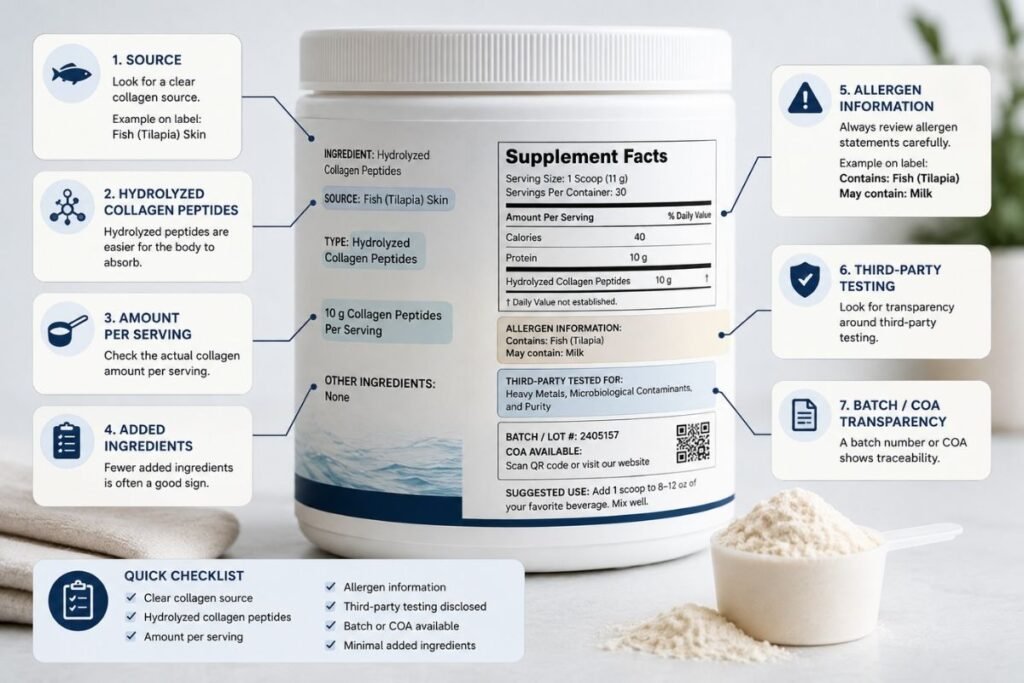
What to Look for on the Label
A trustworthy collagen product should clearly identify its source (marine or bovine), use hydrolyzed collagen peptides where appropriate, and state the actual collagen amount per serving rather than burying it in a proprietary blend. Source traceability is another useful signal — for marine collagen, that might include the fish species, origin, and wild-caught status; for bovine collagen, origin, and grass-fed or pasture-raised claims.
Grass-Fed vs Wild-Caught: What Do These Claims Really Mean?
These terms describe how the animal was raised or caught — not the quality, purity, or effectiveness of the finished collagen product. A “grass-fed” or “wild-caught” label doesn’t tell you anything about hydrolysis quality, contaminant testing, or how much actual collagen is in a serving. It’s a data point, not a guarantee.
Third-Party Testing and COAs
Look for products that disclose relevant third-party testing, particularly for contaminants like heavy metals, and that make a Certificate of Analysis (COA) available. It’s worth checking what was actually tested rather than assuming “third-party tested” automatically covers everything relevant — some testing covers potency, some covers contaminants, and they aren’t the same thing.
Marketing Red Flags
Vague front-label language — “premium,” “clinical grade,” “maximum absorption,” “beauty collagen,” “superior bioavailability” — is common across both marine and bovine products and is worth treating skeptically unless it’s backed by disclosed, verifiable testing or certifications. A decorative logo isn’t the same as a verified certification.
7-Point Collagen Quality Checklist
- Clearly stated collagen source (marine or bovine)
- Hydrolyzed peptide formulation
- Transparent collagen amount per serving
- Clear allergen disclosure
- Traceable sourcing information
- Relevant independent/third-party testing
- Reasonable cost per serving or per gram
To see how this plays out, picture two hypothetical labels side by side: one lists a modest collagen amount per serving, discloses its testing, and is reasonably priced. The other uses terms like “clinical grade” and “maximum absorption” prominently but doesn’t disclose collagen amount or testing at all. The first, less flashy product is generally the better choice — transparency tends to be a better predictor of quality than marketing language.
Marine or Bovine Collagen: Which One Makes More Sense?
Start with any allergies or dietary restrictions, since these can eliminate one option immediately. From there, identify your main goal — skin, joints, general nutrition support — and weigh it against the evidence discussed above rather than a brand’s marketing positioning. Then evaluate the specific product’s formulation and quality, check its testing and source transparency, consider whether the taste and format fit your routine, and finally ask whether the ongoing cost is realistic for you long-term (the cost comparison above covers this in more detail).
Choose Marine Collagen If…
- You avoid bovine ingredients
- You follow a pescatarian diet
- A predominantly Type I product fits your preference
- Fish-derived ingredients are compatible with your allergies and dietary requirements
- You find a transparent, well-tested product
- The ongoing cost is acceptable to you
Choose Bovine Collagen If…
- You’re comfortable consuming bovine ingredients
- You prefer a source that commonly provides both Type I and Type III collagen
- You want broad product availability
- Long-term affordability is a priority
- You find a transparent, appropriately tested product
Either May Work If…
- Both sources fit your diet
- Neither presents an allergy concern
- The formulation is appropriate for your needs
- Product quality and testing are satisfactory
- The product fits your budget and daily routine
- Your expectations match the available evidence
You May Not Need Either If…
- You’re expecting collagen to treat a medical condition
- You’re expecting dramatic or immediate results
- Your overall protein or nutritional intake needs attention first
- The supplement doesn’t address a meaningful nutritional or lifestyle need for you
A few quick scenarios can help this feel more concrete. A skin-focused shopper with no dietary restrictions might lean marine for the Type I concentration, but should still verify testing before paying the premium. A budget-conscious daily user with no fish-allergy concerns is often better served by a transparent, affordable bovine product. Someone following a pescatarian diet has a straightforward answer: marine collagen fits the diet in a way bovine collagen simply cannot. An active adult focused on general connective-tissue support may find either source reasonable, provided the formulation and testing hold up. And a shopper with a known fish allergy has an easy decision: bovine collagen, or another non-fish source, is the safer starting point.
Do You Need Vitamin C With Collagen?
Vitamin C does matter for normal collagen production, but getting enough of it is more important than taking it alongside every scoop of collagen.
Why Vitamin C Matters
Vitamin C plays a role in the body’s normal collagen synthesis process — it’s involved in the biochemical steps your body uses to build and stabilize its own collagen. This is a different mechanism than simply helping supplemental collagen peptides “absorb better,” which is a common misconception. Vitamin C supports your body’s own collagen-production machinery; it doesn’t act as a delivery booster for the collagen peptides you swallow.
Food vs Vitamin C Supplements
Many common foods — citrus fruits, bell peppers, strawberries, broccoli — provide meaningful amounts of Vitamin C. People who already meet their Vitamin C needs through food may not need an additional Vitamin C supplement solely because they take collagen.
Timing vs Consistency
Exact timing — whether you take collagen before, after, or alongside a Vitamin C source — is generally less important than simply maintaining a consistent daily routine. A practical approach is pairing your collagen with a normal meal that happens to include a Vitamin C food source, such as breakfast with fruit, rather than engineering a complicated supplement schedule around it.
Final Thoughts
The Marine vs bovine collagen decision is simpler than the marketing makes it sound. Marine collagen makes sense for pescatarians and people avoiding bovine ingredients, while bovine collagen is usually easier on the budget and commonly provides both Types I and III. Paying more for marine collagen doesn’t guarantee better absorption or better results.
I’d choose based on allergies and diet first, then product quality, your goals, taste, and what you can comfortably afford to keep using. A transparent, well-tested collagen that fits your routine is a better buy than a premium label making bigger promises.
Frequently Asked Questions
What is the main difference between marine collagen and bovine collagen?
Marine collagen is typically derived from fish skin or scales and is predominantly Type I collagen, while bovine collagen comes from cattle hides or connective tissue and commonly contains both Type I and Type III collagen. The practical differences that matter most for most people are dietary compatibility, taste, and cost, rather than one source being inherently more effective.
Is marine collagen really absorbed better by the body than bovine collagen?
Some marine collagen products are marketed around smaller peptide size, but this depends on how a specific product is processed rather than being guaranteed by the fish source alone. Even where absorption differences exist, they don’t automatically translate into better real-world results like improved skin or joint outcomes.
Do collagen supplements actually improve skin aging, or are they just marketing hype?
Some research suggests modest improvements in skin hydration and elasticity with consistent, longer-term collagen use, though results are gradual rather than dramatic. This applies similarly to both marine and bovine sources, since both commonly provide Type I collagen.
Which collagen type is better for skin, hair, and nails: marine or bovine?
For skin, both sources provide Type I collagen and have comparable evidence behind them. For hair and nails, evidence is less established for either source, so overall nutrition and protein intake typically matter more than the choice between marine and bovine collagen.
Which collagen is better for joint health and gut repair?
Bovine collagen is often positioned for connective-tissue support because of its Type I and Type III content, but this shouldn’t be read as clear superiority over marine collagen for joints. Neither marine nor bovine collagen has been established as a treatment for “gut repair” — current human evidence for either source remains limited, and claims about “repairing” or “healing” the gut go beyond what’s currently supported.
Should I take collagen supplements together with Vitamin C?
Vitamin C supports your body’s own natural collagen synthesis process, which is different from directly boosting the absorption of supplemental collagen peptides. People who already meet their Vitamin C needs through food may not need an additional supplement just because they take collagen.
Does marine collagen have a noticeable fishy taste or odor?
Some marine collagen products have a mild fishy smell or aftertaste, though this varies significantly by brand and formulation quality. A well-processed product can be nearly undetectable in a smoothie or beverage.
Is marine collagen safe from heavy metals like mercury?
Marine ingredients can be associated with contaminant concerns like mercury due to environmental exposure, but this doesn’t mean every marine collagen product is contaminated. Checking for third-party contaminant testing and a disclosed Certificate of Analysis is the most reliable way to evaluate safety, rather than relying on labels like “wild-caught” alone.
Related Reading
- Vegan Collagen Explained — Learn what “vegan collagen” really means and how plant-based collagen builders differ from animal-derived collagen.
- Collagen Before and After — See what changes you can realistically expect from collagen supplements and how long results may take.
- Fish Oil vs Krill Oil vs Algae Oil — Compare three popular omega-3 sources by nutrition, dietary fit, and everyday use.
- Fish Oil Benefits — Learn what fish oil may support, what the research says, and when supplementation makes sense.
- Probiotics for IBS and Gut Health — Explore probiotic strains, gut-health uses, and what to consider before choosing a supplement.
❤️ A Final Note
Better health doesn’t come from a single supplement—it comes from making informed choices, one habit at a time.
At OptuVit, we’re here to simplify the world of nutrition and supplements with practical, evidence-based guidance you can trust. Whether you’re exploring collagen, vitamins, minerals, or everyday wellness, our mission is to help you build a nutrition routine that fits your life and supports your long-term health.
Because healthy living isn’t about perfection—it’s about making better choices, every day.