
Marine collagen has become one of the most talked-about collagen supplements, especially for skin, hair, and nail support. Its premium price often leads to one question: does it really offer advantages over bovine collagen, or is it simply more expensive?
This guide explains what marine collagen is, how it compares with bovine collagen, what current research says about its potential benefits, and how to choose a quality product that fits your goals and budget.
Overview: Quick Answer
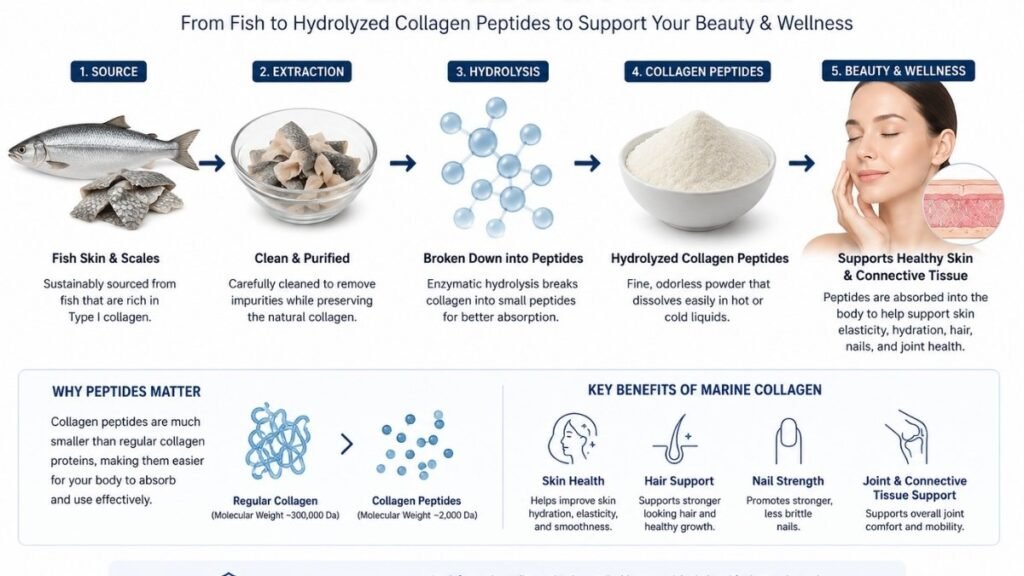
Marine collagen is a hydrolyzed collagen peptide supplement derived mainly from fish skin and scales, most commonly containing Type I collagen — the type most associated with skin, hair, and nail support.
Here’s what matters most before you buy:
- Marine collagen is not automatically superior to bovine collagen; the right choice depends on your goals, diet, and budget.
- Look for products with hydrolyzed marine collagen peptides, transparent sourcing, and third-party heavy metal testing.
- Avoid products with unnecessary fillers or vague sourcing claims.
- Marine collagen tends to be a good fit for pescetarians, people avoiding bovine-derived ingredients, and those focused specifically on skin support.
Is Marine Collagen Right for You?
- Choose marine collagen if: you avoid beef products, prefer fish-based ingredients, or are primarily focused on skin hydration and elasticity.
- Consider bovine collagen instead if: budget is a priority or you want a broader Type I and Type III blend.
- Either way: consistency over 8–12 weeks matters more than which source you pick.
What Is Marine Collagen? From Fish to Collagen Peptides
Marine collagen is made from fish skin, scales, and sometimes bones. During processing, the collagen is broken down into small peptides that dissolve easily and are absorbed more efficiently than whole collagen. This hydrolyzed form is the one used in most modern collagen supplements.
Where Does Marine Collagen Come From?
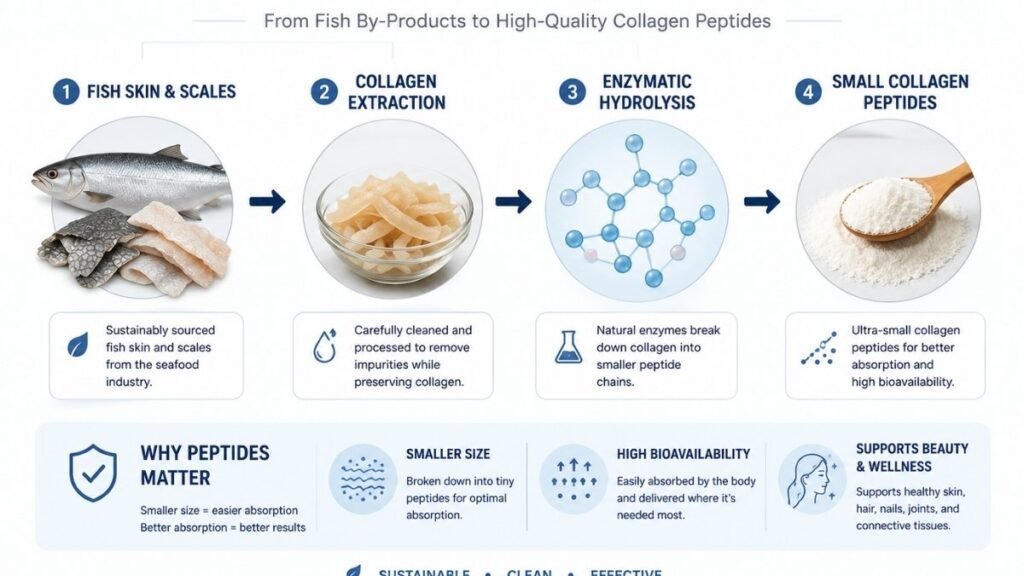
Most marine collagen is extracted from parts of the fish that would otherwise go to waste: skin, scales, and occasionally bones. This makes it, in many cases, a byproduct of the seafood industry rather than requiring fish to be caught specifically for collagen production.
Sourcing quality varies. Some brands use wild-caught fish, while others rely on farmed fish — and sustainability practices differ significantly between suppliers. If sustainability matters to you, it’s worth looking for brands that disclose their fishing or farming practices rather than using vague terms like “ocean-sourced” without further detail.
Why Is Marine Collagen Hydrolyzed Into Peptides?
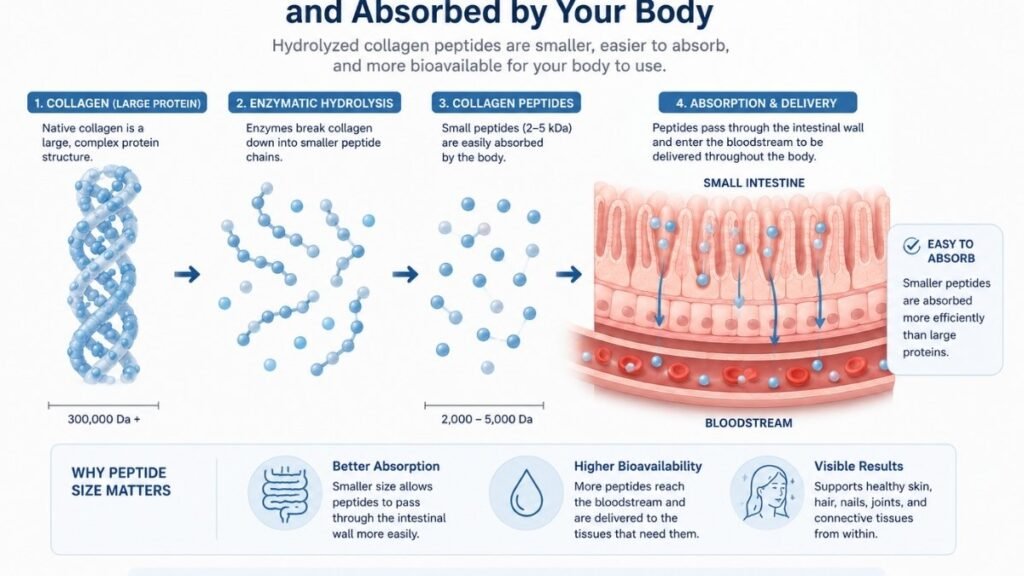
Native collagen — the intact protein structure found in fish skin — is too large for the body to absorb efficiently. Manufacturers use an enzymatic hydrolysis process to break it down into smaller peptide chains, which are far easier for the digestive system to process and absorb into the bloodstream.
This is an important distinction: taking a marine collagen supplement is not the same as simply eating fish skin. The hydrolysis process changes the protein structure specifically to improve absorption, which is why hydrolyzed peptides — not whole collagen — are the standard form used in most reputable supplements and in the clinical research behind them.
Marine Collagen Production Process
Fish source → Extraction → Hydrolysis → Collagen peptides
Key takeaway: Marine collagen supplements are processed into smaller peptides from fish-derived collagen sources to make daily supplementation more practical and better absorbed.
Marine Collagen Benefits: What Does the Research Say?
Marine collagen is best known for supporting healthy skin, but it may also benefit hair, nails, and other connective tissues. Research suggests these benefits are usually gradual rather than dramatic, making realistic expectations just as important as choosing the right supplement.
Skin Health Benefits
Marine collagen may help support skin moisture retention and elasticity when taken consistently over time. Some people also notice a healthier-looking skin appearance after several weeks of regular use. These effects tend to be gradual rather than dramatic — a more detailed breakdown of realistic timing can be found in our guide to collagen before and after results.
Hair and Nail Support
Nails often respond earlier than other areas, sometimes showing improved strength within a few weeks. Hair structure support is also commonly reported, though individual results vary considerably — genetics, overall nutrition, and hair care habits all play a role alongside supplementation.
Joint and Connective Tissue Support
Collagen, including marine-derived collagen, plays a general structural role in connective tissue throughout the body. That said, it’s worth noting that joint-specific research often focuses more heavily on Type II collagen rather than the Type I collagen predominant in most marine collagen products — so if joint support is your primary goal, it’s worth checking which collagen type a product actually contains.
Marine Collagen Benefits by Health Goal
| Health Goal | Possible Support | Important Considerations |
|---|---|---|
| Skin | Hydration and elasticity support | Results vary by individual |
| Hair | Structural support | Requires adequate overall nutrition |
| Nails | Strength support | Often the first visible change |
| Joints | General connective tissue support | Type II collagen may be more targeted |
Visible changes rarely happen overnight. Skin often feels a little less dry before any difference shows up in the mirror, and stronger nails are usually one of the first things people notice. The changes are subtle at first, which is why marine collagen is better viewed as a long-term habit than a quick fix.
Marine Collagen vs Bovine Collagen: Which Should You Choose?
At first glance, marine collagen and bovine collagen seem almost the same, which is why they’re often compared. The real differences are less about which one is “better” and more about collagen types, ingredient source, cost, and personal preferences.
Source and Collagen Type Differences
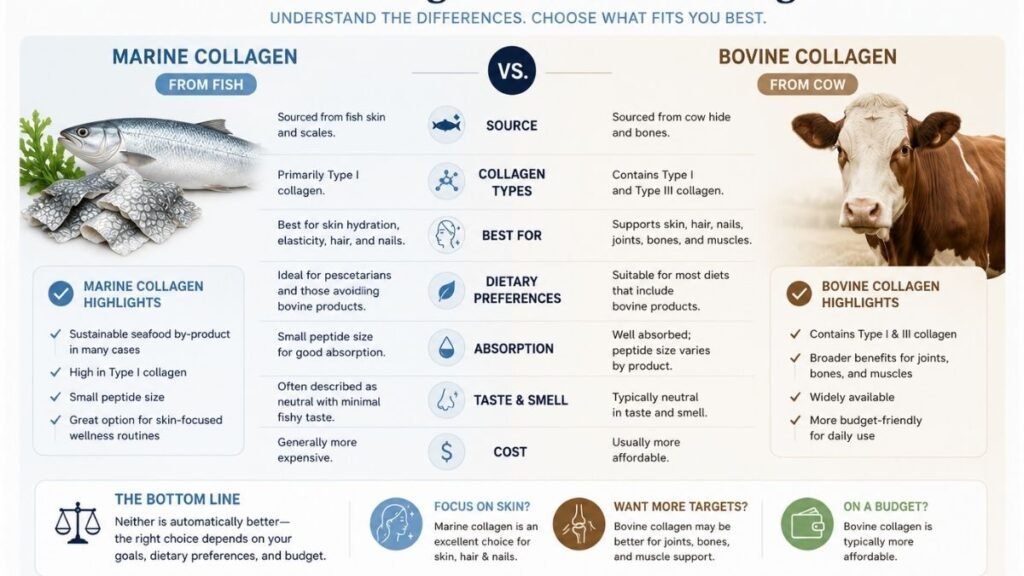
Marine collagen is fish-derived and predominantly contains Type I collagen. Bovine collagen is derived from cows and typically contains a blend of Type I and Type III collagen, which some people prefer for broader skin and connective tissue support.
Is Marine Collagen More Absorbable?
Marine collagen peptides sometimes have a smaller average molecular size than bovine collagen peptides, which has led to marketing claims of “superior absorption.” In reality, the evidence for a meaningful, practical difference in absorption between well-hydrolyzed marine and bovine collagen is limited. Both forms are broken down into similar amino acids and peptides during digestion — the difference in molecular size doesn’t necessarily translate into dramatically different results.
Who May Prefer Marine Collagen?
Marine collagen tends to be a better fit for pescetarians, people avoiding bovine-derived ingredients for religious, ethical, or dietary reasons, and those who are primarily focused on skin-specific goals rather than broader connective tissue support.
Marine vs Bovine Collagen
| Feature | Marine Collagen | Bovine Collagen |
|---|---|---|
| Source | Fish | Cow |
| Common Types | Type I | Type I & III |
| Popular Uses | Skin-focused | Skin + connective tissue |
| Dietary Compatibility | Pescetarian-friendly | Not suitable for some users |
| Cost | Usually higher | Often more affordable |
Marine collagen is often priced higher due to sourcing and processing costs, not because it consistently outperforms bovine collagen in clinical outcomes. If you’re not restricted by diet or ethical preference, the decision often comes down to budget and personal preference rather than one option being objectively “better.”
Neither marine nor bovine collagen is suitable for those following a plant-based diet, since both are animal-derived. If that applies to you, our guide to vegan collagen explained covers plant-based approaches that support your body’s own collagen production instead.
How Nutrition Can Help You Get More From Marine Collagen
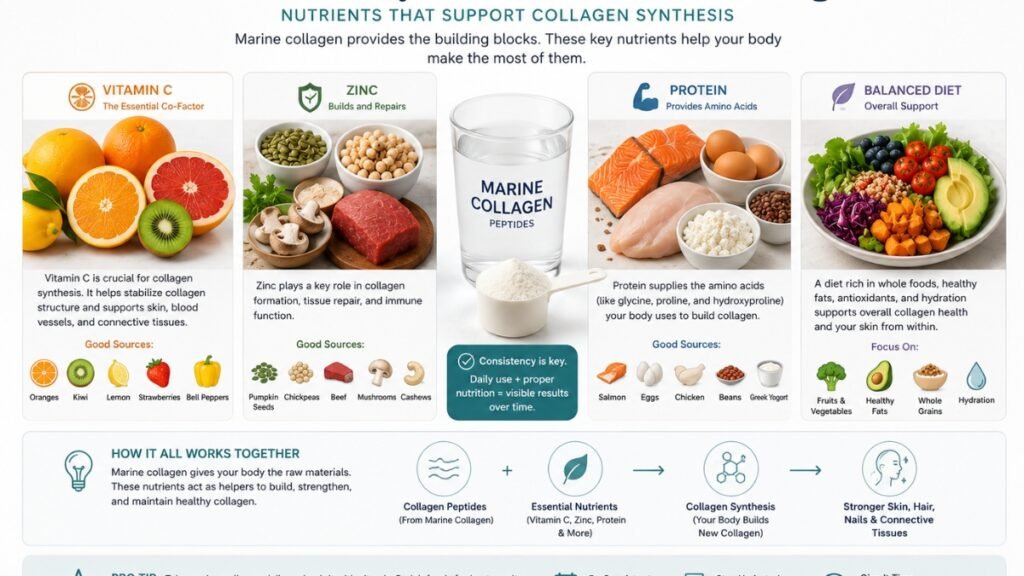
Taking marine collagen is only one part of the picture. Nutrients like vitamin C, along with enough protein in your daily diet, help support your body’s natural collagen production and make your supplement routine more effective.
Why Vitamin C Matters for Collagen Production
Vitamin C is a required cofactor for collagen synthesis. Without adequate vitamin C, your body cannot properly form new collagen, regardless of how much marine collagen you’re consuming. Citrus fruits, bell peppers, and berries are all practical everyday sources.
Nutrients That Support Healthy Collagen Formation
Zinc and copper both play supporting roles in collagen and elastin formation. Adequate overall protein intake is equally important, since collagen peptides alone don’t provide a complete amino acid profile for general tissue repair.
Building a Daily Supplement Routine
A skin-focused routine typically pairs marine collagen with a vitamin C source and consistent sun protection. A broader healthy-aging routine might also include adequate protein at each meal and attention to overall dietary balance — collagen works as an addition to a healthy diet, not a replacement for one.
Daily Collagen Support Checklist
- [ ] Marine collagen peptides (as directed on the product label)
- [ ] A vitamin C source alongside your dose
- [ ] Adequate protein intake throughout the day
- [ ] Balanced, varied meals
- [ ] Daily sun protection
Marine collagen works best as part of a balanced diet, not as a standalone solution. Without enough protein and vitamin C, improvements may be slower and less noticeable because your body needs these nutrients to support collagen production.
How to Use Marine Collagen: Best Forms, Dosage, and Taste Tips
Finding a marine collagen product you enjoy using is often more important than choosing the most expensive one. Whether it’s powder, capsules, or liquid, a format that fits naturally into your daily routine is the one you’re most likely to keep using.
Powder, Capsule, or Liquid: Which Form Works Best?
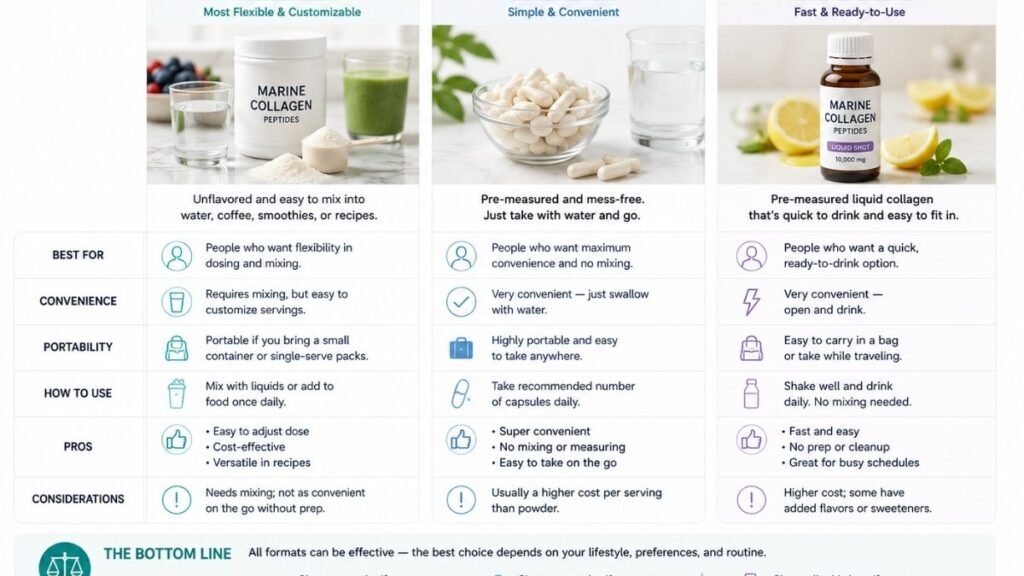
Powder is generally the most flexible and cost-effective option, since it allows you to adjust your dose and mix it into a variety of foods and drinks. Capsules are convenient for travel but often require taking several to reach an effective daily dose, since each capsule can only hold a limited amount. Liquid marine collagen is easy to consume without mixing but tends to cost more and sometimes contains additional additives for flavor or preservation.
Marine Collagen Forms Compared
| Form | Advantages | Limitations |
|---|---|---|
| Powder | Affordable, flexible dosing | Requires mixing |
| Capsule | Convenient, portable | Lower dose per serving |
| Liquid | Easy to consume | Higher cost, more additives |
How to Reduce Fishy Taste and Clumping
Marine collagen can have a mild fishy taste and, if mixed poorly, can clump rather than dissolve smoothly. Mixing it into strongly flavored liquids — smoothies, coffee, yogurt, or citrus-based drinks — tends to mask any taste effectively. Using a shaker bottle or blending briefly, rather than simply stirring with a spoon, usually solves clumping issues. Storing the product in a cool, dry place also helps maintain solubility over time.
In everyday use, people who successfully stick with a collagen routine long-term usually build it into an existing habit — stirring it into a morning coffee, blending it into a post-workout smoothie, or mixing it into breakfast yogurt — rather than treating it as a separate task to remember.
Marine Collagen Safety: How to Choose a Quality Product
Not all marine collagen supplements are made to the same standard. Checking the ingredient source, third-party testing, and product quality can help you choose a safer and more reliable option.
How to Choose a Cleaner Marine Collagen Product
Look for products that disclose their fish source, use hydrolyzed peptides, and provide third-party testing results for heavy metals like mercury. Minimal additives and clear labeling are also good signs of a quality-focused brand. Concerns about microplastics in marine-sourced ingredients have been raised in some contexts; reputable brands that test their raw materials and finished products help reduce this risk, though no supplement can guarantee complete absence of environmental contaminants.
Who Should Be More Careful?
People with a known fish or seafood allergy should avoid marine collagen entirely, since allergic reactions to fish-derived proteins are possible even after processing. Pregnant individuals and people managing complex medical conditions should check with a healthcare provider before adding any new supplement. This is particularly relevant for anyone with a hormone-sensitive condition or a history of certain cancers, where individualized medical guidance — rather than general supplement advice — is the appropriate next step.
Before Buying Marine Collagen — Checklist
- [ ] Confirms hydrolyzed marine collagen peptides
- [ ] Clearly discloses the fish source
- [ ] Provides third-party heavy metal testing
- [ ] Free from unnecessary fillers or added sugars
- [ ] Uses transparent, specific labeling (not vague marketing terms)
Key takeaway: A high-quality marine collagen supplement should prioritize safety testing, transparency, and suitability for your personal needs.
Frequently Asked Questions
What is the main difference between marine collagen and bovine collagen, and which one is better for skin aging? Marine collagen is fish-derived and mainly Type I collagen, while bovine collagen is cow-derived and typically contains a blend of Type I and Type III. Neither has been shown to be conclusively superior for skin aging — the better choice usually depends on dietary preferences and budget rather than proven performance differences.
Does marine collagen actually help with thinning skin, fine lines, and joint dry pain during menopause? Marine collagen may offer modest support for skin hydration and elasticity during menopause, when natural collagen production declines more rapidly. For joint-specific concerns, however, Type II collagen or other targeted joint supplements may be more directly relevant, since most marine collagen is Type I.
How do I get rid of the fishy taste and clumps when mixing marine collagen powder into drinks? Mixing marine collagen into strongly flavored liquids like coffee, smoothies, or citrus drinks generally masks any fishy taste effectively. Using a shaker bottle or blending briefly, rather than just stirring, also helps prevent clumping and ensures a smoother texture.
Is marine collagen safe from heavy metals like mercury and microplastics? Reputable marine collagen brands conduct third-party testing for heavy metals like mercury to ensure levels stay within safe limits. Choosing a brand with transparent sourcing and published testing results is the most practical way to reduce exposure risk.
Is it safe to take marine collagen supplements if I have a history of hormone-sensitive conditions or breast cancer? This is a situation where individualized medical guidance is essential rather than general supplement advice, since interactions with hormone-sensitive conditions can vary significantly by individual. Speak with your healthcare provider before starting marine collagen or any new supplement if this applies to you.
How long does it take to see visible results in hair, skin, and nails after taking marine collagen? Nails often show early changes within a few weeks, while skin hydration and elasticity improvements typically become more noticeable after 8–12 weeks of consistent use. Our detailed guide on collagen before and after results breaks this timeline down week by week.
Should I take marine collagen in powder, capsule, or liquid form for maximum absorption? All three forms use hydrolyzed collagen peptides, and there’s no strong evidence that one form is meaningfully better absorbed than another. The best format is usually whichever one you’ll use consistently as part of your daily routine.
Do I need to take Vitamin C alongside marine collagen for it to work properly? Vitamin C is a required cofactor for collagen synthesis, so adequate intake supports your body’s ability to actually use the collagen peptides you’re consuming. Pairing your supplement with a vitamin C-rich food or drink is a simple, practical way to support better results.
Final Thoughts
Choosing marine collagen doesn’t have to be complicated. It’s not a miracle supplement, and it won’t replace a healthy diet, but it can be a worthwhile addition if your goal is to support healthier-looking skin, stronger nails, or your overall wellness routine. Focus on a quality product, stay consistent, and give it time. Small changes are often the ones that last the longest.
📝 Editor’s Note
Collagen supplements are often surrounded by bold marketing claims, making it difficult to know what really matters. This guide focuses on practical, research-based information to explain what marine collagen is, how it compares with bovine collagen, and what to look for before buying. The goal is simple: help you make a confident decision based on evidence, not advertising.
Editor’s Take: The best collagen supplement isn’t always the most expensive—it’s the one that matches your goals, your diet, and your long-term routine.
🌿 Continue Building Your Nutrition Knowledge
Marine collagen is just one piece of a healthy nutrition routine. These evidence-based guides can help you better understand essential nutrients, recognize common deficiencies, and choose supplements that fit your health goals.
- Fish Oil Benefits — Discover how fish oil supports heart, brain, eye, and joint health, and learn who may benefit most from adding it to their daily routine.
- Omega-3 Deficiency Symptoms — Learn the common signs of low omega-3 intake, what may cause a deficiency, and when increasing your intake could help.
- Fish Oil vs. Krill Oil vs. Algae Oil — Compare the three most popular omega-3 supplements, including their benefits, differences, and which option may be right for your lifestyle.
- Vitamin D Deficiency Symptoms — Explore the warning signs of low vitamin D, why it matters for overall health, and practical ways to improve your vitamin D status.
❤️ A Final Note
Better health doesn’t come from a single supplement—it comes from making informed choices, one habit at a time.
At OptuVit, we’re here to simplify the world of nutrition and supplements with practical, evidence-based guidance you can trust. Whether you’re exploring collagen, vitamins, minerals, or everyday wellness, our mission is to help you build a nutrition routine that fits your life and supports your long-term health.
Because healthy living isn’t about perfection—it’s about making better choices, every day.