

You’ve tried the usual advice. No screens before bed. Chamomile tea. Keeping the room cool. Maybe even melatonin for a while. And yet — you still lie there, wide awake at 1 a.m., watching the ceiling do nothing.
Someone mentioned magnesium glycinate. Maybe it was a friend, maybe a Reddit thread, maybe a passing comment from your doctor. You looked it up. Now you’re here, wondering: is this actually worth trying, or is it just another supplement that sounds promising and delivers nothing?
That’s a fair question. And you deserve a straight answer — not a list of vague benefits with a dozen asterisks.
Here’s what magnesium glycinate can realistically do for sleep, what the research actually shows (with real numbers, not just “studies suggest”), how to take it in a way that gives it a proper chance to work, and — importantly — what to do if it doesn’t.
Key Takeaways
- Magnesium glycinate is one of the most absorbable, stomach-friendly forms of magnesium — and the form most commonly studied for sleep and relaxation support.
- It works by supporting GABA activity in the brain (your nervous system’s natural “calm down” signal) and helping regulate melatonin production.
- A 2012 randomized controlled trial published in the Journal of Research in Medical Sciences found that magnesium supplementation reduced the time it took older adults with insomnia to fall asleep and improved sleep efficiency over 8 weeks.
- Typical starting dose: 200 mg of elemental magnesium (not total compound weight) taken 30–60 minutes before bed.
- Most people notice gradual improvement over 1–3 weeks. If you expect it to work like a sleeping pill on night one, you’ll be disappointed — and that expectation is worth adjusting before you start.
- It is not a treatment for sleep apnea, clinical insomnia disorder, or depression-related sleep disruption. If those are in the picture, a doctor needs to be involved.
What Is Magnesium Glycinate, and Why This Form Specifically?
Magnesium is an essential mineral involved in over 300 enzymatic reactions in the body — including several that directly regulate how your nervous system winds down at night. The problem is that a significant portion of adults don’t get enough of it through diet alone. The NIH estimates that a large percentage of Americans consume less than the recommended daily amount of magnesium, and poor sleep is one of the more commonly reported consequences.
But not all magnesium supplements are the same. The form matters — a lot.
Magnesium glycinate is magnesium bound to glycine, an amino acid. This pairing gives it two distinct advantages. First, glycine helps carry the magnesium across the intestinal wall more effectively, meaning more of it actually reaches your bloodstream instead of passing through unused. Second, glycine itself has calming properties — it’s involved in inhibitory neurotransmission and has been shown in research to lower core body temperature slightly, which is one of the signals your body uses to initiate sleep.
Compare this to magnesium oxide (cheap, poorly absorbed, often causes digestive upset), magnesium citrate (better absorbed but a known laxative at higher doses), or magnesium threonate (specifically designed to cross the blood-brain barrier, better for cognitive support than general sleep). For sleep support in a general adult population, glycinate is consistently the form most practitioners reach for first.
One note worth mentioning: some supplements are labeled “magnesium bisglycinate” — this is essentially the same compound, just a slightly different naming convention. If you see either on a label, they’re referring to the same thing.
How Magnesium Glycinate Supports Sleep: The Mechanism (Without the Jargon)
Here’s what’s actually happening in your body when magnesium glycinate does its job.

It activates your brain’s natural brake system
Your brain has two main modes: excitatory (active, alert, reactive) and inhibitory (calm, winding down). The inhibitory side is largely governed by a neurotransmitter called GABA (gamma-aminobutyric acid). Magnesium helps activate GABA receptors — essentially turning up the volume on your brain’s “settle down” signal. Low magnesium levels have been associated with a hyperactive nervous system, which shows up at night as racing thoughts, light and restless sleep, or difficulty staying asleep.
This is also the same system that prescription sleep medications like benzodiazepines target — but they do so forcefully and with significant side effects. Magnesium works much more gently, supporting the system rather than overriding it.
It helps regulate your sleep-wake rhythm
Magnesium is involved in the enzymatic pathway that produces melatonin — your body’s main sleep-onset hormone. It doesn’t flood you with melatonin the way a supplement does. Instead, it supports the body’s own natural production, which tends to result in a more gradual, natural transition into sleep rather than a sudden drop-off.
It lowers the physical tension that keeps you awake
Muscle tension at night — tight shoulders, clenched jaw, restless legs — is a real and underappreciated sleep disruptor. Magnesium is essential for proper muscle relaxation. When levels are low, muscles have more difficulty releasing contraction. If you’ve ever noticed that you physically can’t seem to “let go” when you lie down, this is sometimes a magnesium issue.
It blunts stress hormones that spike at night
Cortisol is supposed to be lowest at night, but chronic stress can flatten that curve or even cause it to rise at bedtime. Magnesium plays a role in regulating the HPA axis (your body’s stress response system), and adequate levels are associated with a more controlled cortisol pattern across the day.
How to Read a Magnesium Label (This Part Matters More Than You Think)
This is where most people go wrong, and where a lot of “I tried magnesium and it didn’t work” stories actually start.
When you pick up a bottle of magnesium glycinate and it says “500 mg magnesium glycinate” on the front — that is not the amount of magnesium your body will absorb. Magnesium glycinate is a compound: part magnesium, part glycine. Only about 14% of the compound’s weight is actual elemental magnesium.
So 500 mg of magnesium glycinate ≈ 70 mg of elemental magnesium.
That’s not very much. You’d need to take several capsules to reach a meaningful dose.
The number that actually matters is elemental magnesium, which should be listed in the Supplement Facts panel. Always check this line, not the front-of-bottle number. A good sleep-support dose is 200–350 mg of elemental magnesium per day.
Here’s a quick reference:
| Label Says | Elemental Magnesium (approx.) |
|---|---|
| 200 mg magnesium glycinate | ~28 mg |
| 500 mg magnesium glycinate | ~70 mg |
| 1,000 mg magnesium glycinate | ~140 mg |
| “200 mg elemental magnesium” | 200 mg ✓ |
The last row is what you want to see. If a product clearly states the elemental magnesium content, you can trust that number directly. If it only lists the compound weight, you’ll need to do the math — or choose a different product that’s more transparent.
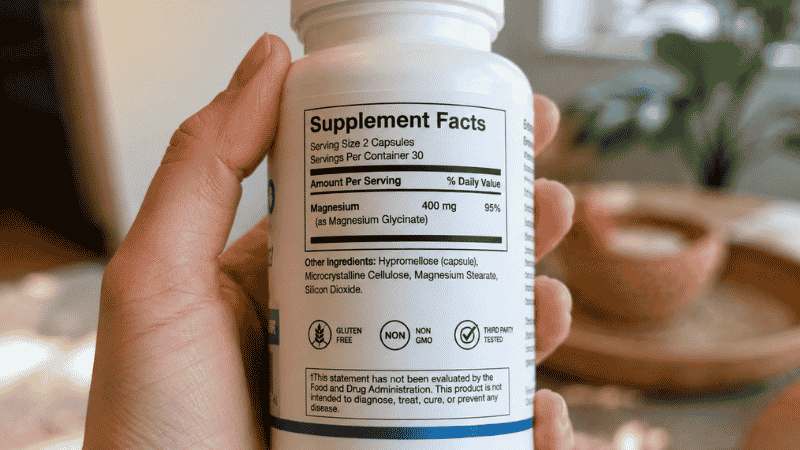
Dosage and Timing: What the Evidence Supports
Starting dose: 100–200 mg of elemental magnesium, taken in the evening.
Maintenance dose: 200–350 mg of elemental magnesium daily. The NIH sets the Tolerable Upper Intake Level for supplemental magnesium at 350 mg/day for adults — meaning amounts beyond that from supplements alone carry a higher risk of side effects.
When to take it: 30–60 minutes before bed is the most commonly recommended window. This gives your body time to absorb it and begin the calming cascade before you’re trying to fall asleep. Taking it with a small amount of food can reduce any chance of mild stomach discomfort, though most people tolerate magnesium glycinate fine on an empty stomach.
Start low, increase gradually. If you begin at 100–150 mg and don’t notice much after two weeks, increase by 50–100 mg increments. There’s no benefit to jumping straight to a high dose — and if your body isn’t used to magnesium supplementation, a high starting dose can cause loose stools even with the gentler glycinate form.
Consistency matters more than precise timing. Taking it every night — even if the timing varies slightly — will produce better results than taking it perfectly on some nights and skipping others.

What to Realistically Expect, Week by Week
Magnesium glycinate is not a sedative. It doesn’t knock you out. If that’s what you’re looking for, this isn’t the right tool.
What it does is support the biological conditions that make sleep easier — calmer nervous system, more regulated melatonin, less physical tension. The effect is cumulative, not immediate.
Days 1–3: Some people notice subtle differences in how relaxed they feel before bed. Most people notice nothing yet, especially if their magnesium stores were low to begin with (the body prioritizes filling tissue stores before you feel any behavioral effect).
Week 1–2: This is when the most consistent early feedback tends to appear: falling asleep slightly faster, fewer nighttime awakenings, feeling marginally less wired in the evening. Don’t expect dramatic changes here — but do pay attention to subtle shifts.
Week 3–4: For most people, this is where the clearer picture emerges. A 2012 placebo-controlled clinical trial found that magnesium supplementation over 8 weeks significantly reduced sleep onset time and improved sleep efficiency in older adults with insomnia. Most participants in sleep studies using magnesium show meaningful results by the 4–6 week mark.
If nothing has changed by week 4: This is meaningful data. It doesn’t necessarily mean magnesium isn’t for you — but it does mean something else might be driving your sleep issues, or that your dose or form needs adjustment. See the section below.
If You’ve Tried It and It’s Not Working
This is the part most articles skip. Let’s not skip it.
There are several reasons magnesium glycinate might not produce noticeable sleep improvement:
1. You’re not taking enough elemental magnesium. Go back to the label. If you’ve been taking 400 mg of magnesium glycinate compound thinking that’s your dose — it’s probably closer to 55 mg of actual magnesium. Increase to 200–300 mg of elemental magnesium and reassess.
2. Your sleep problem isn’t primarily a magnesium issue. Magnesium works best when magnesium insufficiency is part of the picture. If your sleep is disrupted primarily by sleep apnea, clinical anxiety, depression, chronic pain, or a circadian rhythm issue, magnesium won’t fix any of those at their root. It’s a nutritional support, not a treatment.
3. You haven’t given it enough time. Two weeks is too early to declare it ineffective. The research timeline is 4–8 weeks of consistent daily use.
4. The product quality is poor. Not all magnesium glycinate supplements are the same. Third-party tested products (look for USP, NSF International, or Informed Sport certifications on the label) are far more likely to contain what they claim at the stated dose.
5. Something else is depleting your magnesium as fast as you’re taking it. High stress, heavy alcohol use, certain medications (especially diuretics, proton pump inhibitors, and some diabetes medications), and high sugar intake all increase magnesium excretion. If any of these are present, you may need to address the underlying drain before supplementation has much visible effect.
Can You Take Magnesium Glycinate With Other Sleep Supplements?
This comes up constantly, and it’s worth addressing directly.
With melatonin: Generally fine. Magnesium and melatonin work through different mechanisms and don’t interfere with each other. Some people find the combination more effective than either alone, particularly for getting to sleep (melatonin) and staying asleep (magnesium).
With L-theanine: Compatible and commonly paired. L-theanine promotes alpha brain wave activity (the relaxed-but-alert state that precedes sleep), and magnesium supports GABA. They complement each other without sedating you in an unpleasant way.
With prescription sleep medications: Do not combine without speaking to your doctor first. Magnesium can influence how some medications are absorbed and metabolized.
With antibiotics: Space magnesium at least 2 hours apart from tetracycline or fluoroquinolone antibiotics — magnesium can bind to these and reduce their effectiveness.
With calcium: The old advice that calcium and magnesium compete for absorption has largely been revised. For most people, taking them together isn’t a problem. But if you’re taking very high doses of both, spacing them a few hours apart is reasonable.
Who Should Be Cautious or Avoid It
Magnesium glycinate is well tolerated by the majority of healthy adults — but there are specific situations where caution is warranted.
Kidney disease: The kidneys are responsible for excreting excess magnesium. Impaired kidney function means excess magnesium can accumulate to dangerous levels. If you have any degree of kidney disease or reduced kidney function, do not supplement magnesium without explicit guidance from your doctor.
Taking diuretics or heart medications: Certain diuretics deplete magnesium, while others retain it. Heart medications can interact with magnesium’s effect on muscle contractility, including the heart muscle. Get clearance from your prescribing physician.
Pregnant or breastfeeding: Magnesium needs do increase during pregnancy. But the right dose and form for your situation is something to confirm with your OB or midwife, not determine from a blog post.
Older adults (65+): Kidney function naturally declines with age. Older adults generally tolerate magnesium glycinate well, but should start at the lower end of the dosing range and have their kidney function monitored if they’re supplementing long-term.
When to See a Doctor Instead of Reaching for a Supplement
Magnesium can support sleep when the underlying issue is nutritional insufficiency, mild stress-related sleep disruption, or general difficulty winding down. It is not a substitute for medical evaluation when the problem runs deeper.
Talk to a doctor if:
- Your sleep problems have persisted for more than 3–4 weeks without improvement
- You regularly wake up feeling unrefreshed no matter how many hours you sleep
- Your partner reports that you snore loudly, stop breathing, or gasp during sleep (these are signs of sleep apnea, which magnesium will not treat)
- You experience significant daytime sleepiness that affects your functioning
- You have mood symptoms — persistent anxiety, low mood — alongside sleep disruption
- You notice heart palpitations, unusual weakness, or confusion (these can signal electrolyte imbalance)
Sleep apnea in particular is underdiagnosed — especially in women, who are less likely to present with the classic loud-snoring profile. If sleep apnea is driving your poor sleep, no supplement will help. It needs diagnosis and direct treatment.

Frequently Asked Questions
Does magnesium glycinate help you sleep the first night? For most people, no — or only very subtly. The mechanisms through which magnesium supports sleep are cumulative and work through gradual nervous system stabilization, not sedation. The first night is more about starting the process than experiencing a result.
Is magnesium glycinate better than melatonin for sleep? They work differently. Melatonin targets the timing of sleep (your circadian clock) and is most useful for jet lag, shift work, or if you have genuine difficulty initiating sleep at the right time. Magnesium targets sleep quality, stress regulation, and physical relaxation. For many people, neither alone is a complete solution — but they can be used together safely.
How do I know if I’m magnesium deficient? Blood serum magnesium tests are available but imperfect — most magnesium is stored in cells and bone, not the bloodstream, so a normal serum level doesn’t rule out tissue insufficiency. More useful signs of low magnesium include: muscle cramps or twitches, difficulty sleeping, fatigue, headaches, and heightened stress sensitivity. If several of these resonate, it may be worth a trial of supplementation (and a conversation with your doctor).
Can I take magnesium glycinate every night long-term? Generally yes, for healthy adults with normal kidney function. Magnesium is a mineral your body uses and excretes daily — it’s not accumulating in a way that creates long-term risk at recommended doses. Some people use it seasonally (during higher-stress periods) and others take it year-round. Both approaches are reasonable.
What’s the difference between magnesium glycinate and magnesium bisglycinate? Functionally, very little. Bisglycinate means two glycine molecules are attached per magnesium atom (technically “fully chelated”), while glycinate may refer to the same compound or a partially chelated version. In practice, both are highly absorbable, stomach-friendly, and used for the same purposes. The difference is more in manufacturing terminology than in real-world effect.
Will magnesium glycinate make me feel groggy in the morning? Unlikely, especially at standard doses. Unlike pharmaceutical sleep aids, magnesium doesn’t produce dependency or a “hangover” effect. Some people find they sleep more deeply initially and feel that as a slight heaviness on waking — but this typically resolves within a week as the body adjusts.
Can magnesium glycinate help with anxiety-related sleep problems? Yes, this is actually one of the stronger use cases. Anxiety that manifests as nighttime rumination, racing thoughts, or an inability to “switch off” is often tied to elevated cortisol and hyperactive nervous system activity — both areas where magnesium’s GABA-supporting and HPA-regulating effects are most relevant. That said, if anxiety is clinically significant, supplementation alone is rarely sufficient.
The Bottom Line
Magnesium glycinate is one of the more genuinely useful supplements available for sleep support — not because it’s a shortcut to unconsciousness, but because it addresses some of the actual physiological reasons sleep becomes difficult: an overactive nervous system, insufficient melatonin regulation, physical tension, and the slow drain of chronic stress on the body’s mineral reserves.
It’s not magic. It won’t fix sleep apnea, override clinical insomnia, or compensate for a genuinely unsustainable schedule. But as nutritional support for a body that’s struggling to wind down — especially if you’ve been under chronic stress, eat a diet low in magnesium-rich foods, or simply notice that your body feels “stuck on” at bedtime — it’s a reasonable, safe, and evidence-supported place to start.
Start at 200 mg of elemental magnesium. Give it four full weeks before making any judgment. Read the label carefully. And if after a genuine trial you’re still not sleeping, go back to the question of what’s actually driving the problem — because that answer matters more than which supplement you try next.
Want to understand how magnesium glycinate compares to other forms like magnesium threonate or magnesium taurate? Read our full comparison: Magnesium Glycinate vs. Threonate for Sleep: Different Problems, Different Solutions (C3)
Not sure how much you should actually be taking? Our dosage guide breaks down the label math: Magnesium Glycinate Dosage for Sleep: How to Read Labels and Calculate Elemental Magnesium (C2)
References
- Abbasi B, Kimiagar M, Sadeghniiat K, Shirazi MM, Minooee M, Rashidkhani B. The effect of magnesium supplementation on primary insomnia in elderly: A double-blind placebo-controlled clinical trial. Journal of Research in Medical Sciences. 2012;17(12):1161–1169.
- Boyle NB, Lawton C, Dye L. The Effects of Magnesium Supplementation on Subjective Anxiety and Stress — A Systematic Review. Nutrients. 2017;9(5):429. doi:10.3390/nu9050429
- National Institutes of Health Office of Dietary Supplements. Magnesium: Fact Sheet for Health Professionals. Updated June 2022. https://ods.od.nih.gov/factsheets/Magnesium-HealthProfessional/
- Rondanelli M, et al. An update on magnesium and bone health. Biometals. 2021. Cited in NIH ODS Magnesium Fact Sheet.
- Held K, Antonijevic IA, Künzel H, et al. Oral Mg(2+) supplementation reverses age-related neuroendocrine and sleep EEG changes in humans. Pharmacopsychiatry. 2002;35(4):135-143.
- Bannai M, Kawai N. New therapeutic strategy for amino acid medicine: glycine improves the quality of sleep. Journal of Pharmacological Sciences. 2012;118(2):145-148. doi:10.1254/jphs.11R04CP