
We’ve all been there. It’s 2:00 AM, and you’re spiraling down a YouTube rabbit hole or staring at the ceiling, calculating exactly how many hours of sleep you’ll get if you fall asleep right now. For those living with an irregular lifestyle—freelancers, shift workers, or high-stress professionals—the nights can feel like a battleground rather than a sanctuary.
Building a night routine isn’t about being perfect. It’s about creating a “buffer zone” between the high-octane stress of your day and the restorative rest your body requires. Let’s look at the science-backed blueprint to mastering your routines in the night.
Why Your Brain Craves a Predictable Night Routine
According to the National Sleep Foundation, a consistent pre-sleep ritual can improve sleep quality by up to 35%. When your schedule is chaotic, your brain loses its natural “anchor.” A routine acts as a Pavlovian trigger: it tells your nervous system to switch from “Sympathetic” (Fight or Flight) to “Parasympathetic” (Rest and Digest) mode.
Case Study: The “Burned-Out Freelancer” Meet Sarah, a graphic designer with an irregular 60-hour work week. She used to work until her eyes burned, then collapsed into bed. The result? 3 hours of tossing and turning. By implementing a simple 20-minute night routine—switching to a physical book and dimming her lights—she reduced her “sleep onset latency” (the time it takes to fall asleep) from 90 minutes to just 15 minutes within two weeks
The 3-Phase Blueprint for Restorative Rest
Phase 1: The “Digital Sunset” (90–120 Minutes Before Bed)
Your eyes are an extension of your brain. Exposure to blue light (450-490nm wavelength) inhibits melatonin—the hormone that makes you sleepy—for up to twice as long as other light sources.
- The 10-Foot Rule: Keep your phone at least 10 feet away from your bed. If you use it as an alarm, buy a dedicated $10 analog clock.
- The “Amber” Shift: Swap overhead LED bulbs for warm-toned lamps (around 2700K). This mimics the natural setting of the sun.
- The “No-Scroll” Zone: Social media triggers “micro-stresses” (dopamine spikes from notifications or FOMO) that keep your brain in an alert state.
Phase 2: The “Brain Dump” & Cognitive Offloading
If you have an irregular life, your mind is likely a browser with 50 tabs open.
- The 5-Minute Journal: Don’t write a novel. Simply list 3 things you’re grateful for and 3 tasks for tomorrow. A study from Baylor University found that people who wrote “to-do lists” fell asleep 9 minutes faster than those who wrote about completed tasks.
- The Fiction Escape: Read something non-work related. Avoid self-help or business books, which trigger “productive” thinking. Opt for fiction to transport your mind elsewhere.
Phase 3: The Physical Prime (The Final 30 Minutes)
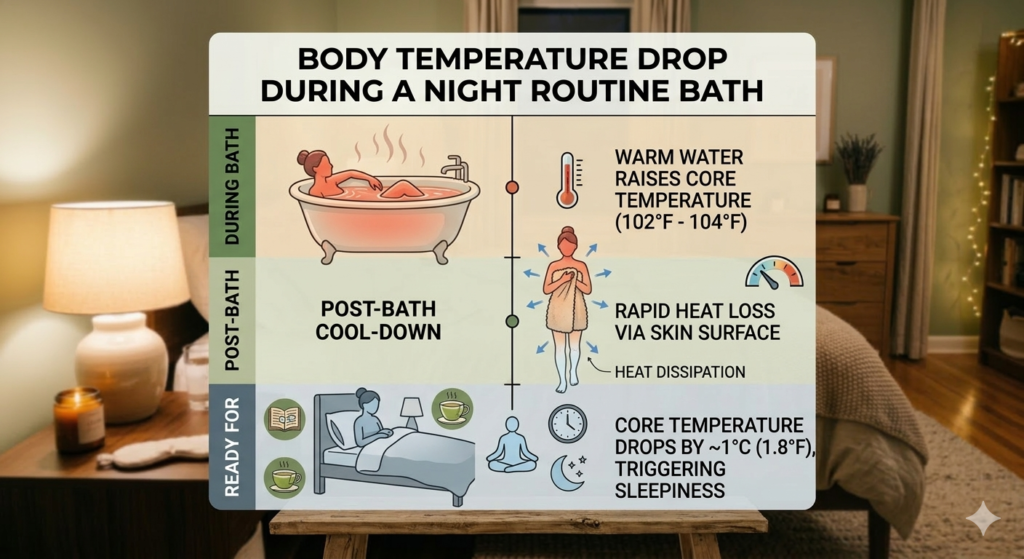
Your body’s core temperature needs to drop by about 2°F (1.2°C) to initiate deep sleep.
- The Warm Bath Paradox: Taking a warm bath (around 104°F or 40°C) 90 minutes before bed causes blood to circulate to your hands and feet. When you step out, that heat dissipates rapidly, forcing your core temperature to drop—the perfect sleep signal.
- Magnesium Magic: Consider a magnesium glycinate supplement (consult your doctor first). Magnesium regulates neurotransmitters that calm the nervous system.
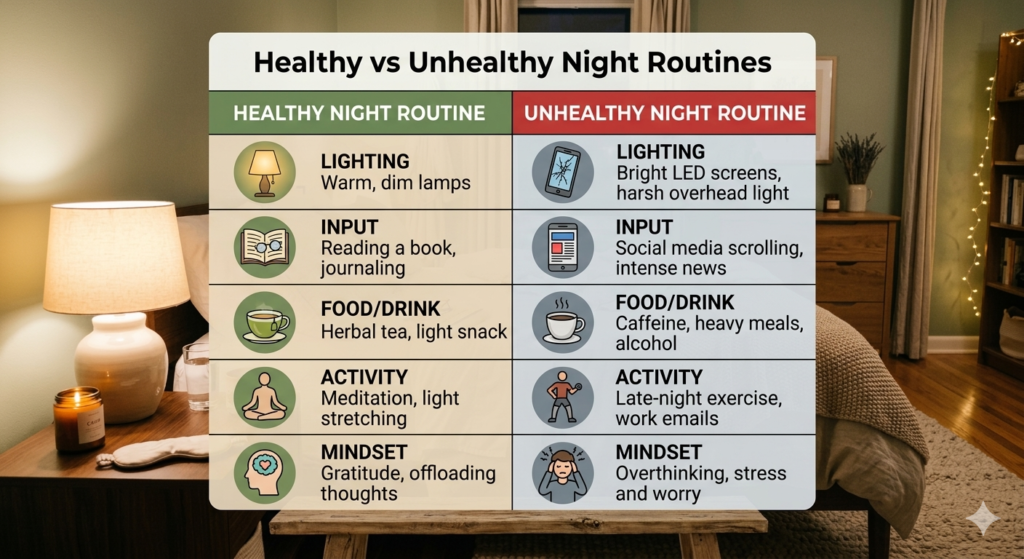
Comparing Habits: What Works vs. What Doesn’t
| Feature | The Sleep Stealer (Avoid) | The Sleep Supporter (Try) |
| Beverage | Nightcap (Alcohol ruins REM sleep) | Tart Cherry Juice or Chamomile Tea |
| Bedroom Temp | 75°F / 24°C (Too hot) | 65°F / 18°C (Optimal for deep sleep) |
| Activity | Late-night HIIT workout | Gentle Yin Yoga or stretching |
| Audio | Stimulating podcasts/True Crime | Brown noise or “Sleep Stories” |
FAQ: Solving the Most Common Hurdles
What exactly is a night routine?
A night routine? It is a series of intentional activities performed in the same order every night to prepare your body for sleep. It’s less about the “what” and more about the “sequence.”
I work night shifts. Can I still have a night routine?
Absolutely. Your “night” just happens at 8:00 AM. Use blackout curtains and follow the same “Digital Sunset” steps, even if the sun is technically rising.
How long should the routine be?
Consistency beats duration. A 15-minute routine you do 7 days a week is far more effective than a 90-minute routine you only do once a month.
Pro-Tips for Success
- The “Reverse Alarm”: Set an alarm for when to start your routine, not just when to wake up.
- Keep it Frictionless: Put your book on your pillow in the morning so it’s waiting for you at night.
- Cool Your Toes: If you can’t cool the whole room, sticking one foot out from under the covers is a scientifically proven way to dump excess body heat!
Conclusion: Start Small, Sleep Deeply
You don’t need a 10-step, celebrity-style night routine to see results. If you are struggling with an irregular lifestyle, the most powerful thing you can do is reclaim the final 30 minutes of your day.
Stop viewing sleep as a “luxury” and start seeing it as the “foundation” of your performance. Pick one habit—just one—and commit to it for the next three nights.