
If you are still taking your supplements whenever you remember, you are missing out on half the benefits. In 2026, the elite wellness community has moved beyond simple dosing to chrono-supplementation. Your body isn’t a static machine; it’s a rhythmic organism governed by a biological clock that dictates when your cells are open for repair and when they are primed for energy. To get 100% absorption, you need to stop fighting your internal rhythm and start feeding it.
H2: The Science of Circadian Rhythms and Nutrient Uptake
Every cell in your body contains a molecular clock. These rhythms control everything from your body temperature to the production of digestive enzymes. When you practice chrono-supplementation, you are essentially “scheduling” your nutrients to arrive exactly when the corresponding metabolic pathways are most active. Taking an energy-boosting molecule like NMN at 9:00 PM is a biological glitch—it tells your body to wake up just as your brain is trying to shut down.
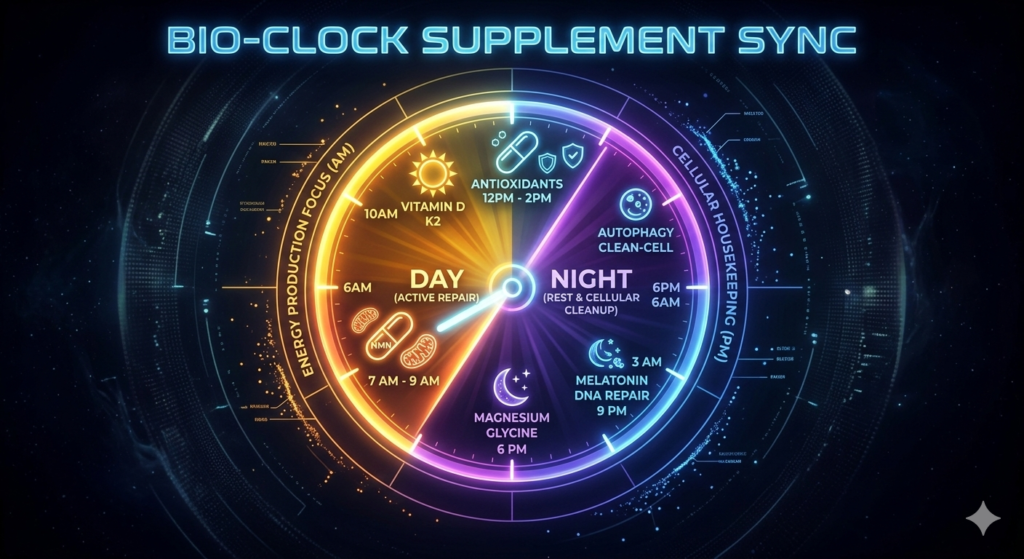
The Morning Peak: Fueling Your Cellular Engine
The first few hours of the day are governed by a natural cortisol curve. This is when your body is naturally wired for “Hunt and Gather” mode.
- The NMN Window: Since NAD+ precursors fuel the mitochondria, the best time to take NMN is between 7:00 AM and 9:00 AM. This aligns with your body’s natural peak in NAMPT—the enzyme that converts NMN into cellular fuel.
- Mitochondrial Activation: By dosing early, you provide the raw materials for ATP production exactly when your brain and muscles need them most, preventing the dreaded “afternoon slump.”
The Evening Repair: Timing for Longevity and Sleep
As the sun goes down, your biological clock shifts from “Energy Production” to “Cellular Housekeeping.” This is the window for recovery supplements.
Avoiding Stimulatory Interference
Taking B-vitamins or high-dose NAD+ boosters late in the day can cause “metabolic friction.” Even if you fall asleep, your cells remain in a high-energy state, reducing the quality of your deep sleep cycles. To maintain a healthy circadian rhythm, keep the “uppers” in the morning and the “downers” at night.
The Autophagy Window and Night-time Repair
During sleep, your body enters a state of autophagy (cellular cleaning). This is the optimal time for minerals like Magnesium or Zinc. According to research on chronobiology published by the Salk Institute, aligning nutrient intake with light-dark cycles is the single most effective way to slow biological aging.
The Optuvit Protocol: Syncing Your Daily Stack
How do you implement this without a degree in biology? Follow the Optuvit Chrono-Map:
- Sunrise (7 AM – 9 AM): Focus on NAD+ boosters (NMN), Vitamin D (mimicking sunlight), and B-Complex. This sets your “Day Mode” switch to ON.
- Mid-Day (12 PM – 2 PM): Fat-soluble antioxidants. Your bile production is highest during your largest meal, ensuring these molecules don’t go to waste.
- Sunset (8 PM – 10 PM): Magnesium, Glycine, or Collagen. These signal to your biological clock that it is time to shift into repair mode.

FAQ: Precision Timing for Biohackers
Q: Does blue light affect when I should take my supplements? A: Absolutely. Blue light from screens tricks your brain into thinking it’s daytime, delaying the “Repair Window.” If you use screens late, you might need to take your evening minerals slightly later to compensate for the shifted rhythm.
Q: Can I “reset” my clock after a long flight? A: Yes. Use a high dose of NMN the morning you arrive at your destination to “force-start” your daytime energy cycle. This is a classic biohacker trick for beating jet lag.
Q: What happens if I take NMN at night by mistake? A: You likely won’t feel “wired” like a caffeine hit, but your REM sleep may be shallower. Balance it out the next morning by getting 15 minutes of direct sunlight to reset your circadian rhythm.