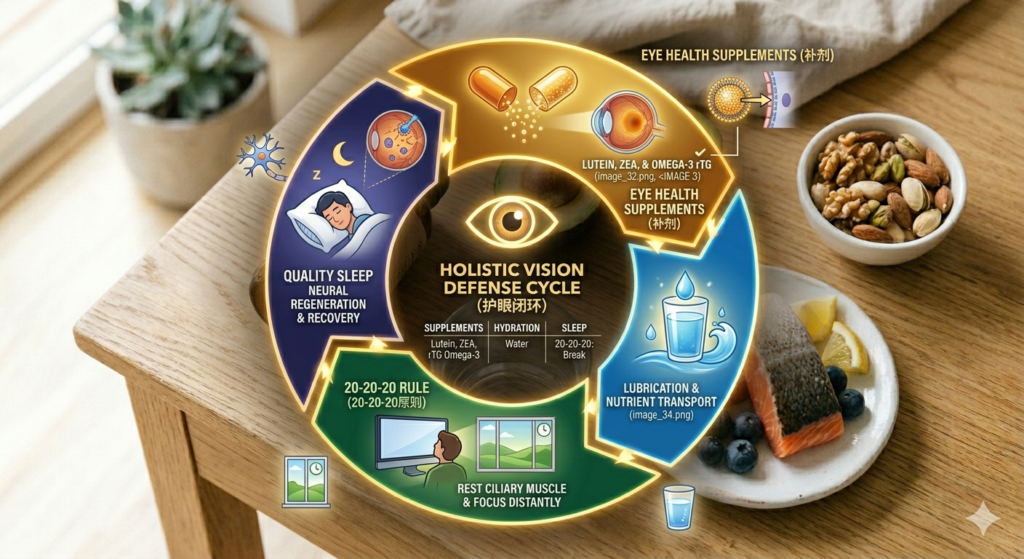
We’ve all been there. It’s 4:30 PM, you’re staring at a spreadsheet or a textbook, and suddenly the text starts to swim. Your eyes feel like they’ve been rubbed with sandpaper, and that dull “behind-the-eye” headache is starting to creep in. You’ve been diligent—you bought a bottle of vitamins for eyes from the local pharmacy, but you aren’t seeing the clarity you were promised.
Here’s the frustrating truth: Most vitamins for eye health never actually reach your retina.
In the wellness landscape of 2026, we’ve learned that “dosage” is meaningless without “delivery.” If your supplement isn’t crossing the Blood-Retinal Barrier (BRB), you’re essentially just creating expensive, neon-colored urine. Today, we’re diving into the bio-hacks that ensure your vitamins for eyesight actually perform.

1. The “Invisible Bouncer”: Understanding the Blood-Retinal Barrier
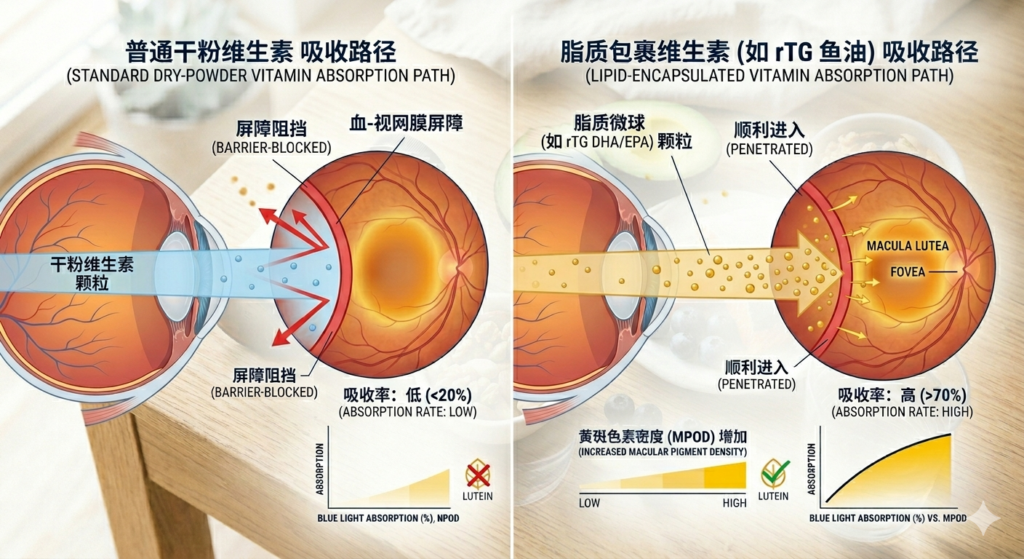
Think of your eyes like a high-end VIP club. They have a biological “bouncer” called the Blood-Retinal Barrier (BRB). This barrier is incredibly picky; it only allows specific, high-quality molecules to pass through to protect your delicate neural tissues from toxins.
Why Dry Tablets are a “No-Go”
Most generic vitamins for eye health come in hard, dry-pressed tablets. These often contain synthetic Beta-Carotene, which a 2025 meta-analysis showed has an absorption rate of less than 12% when taken without a lipid carrier. Your macula is essentially a “fat-loving” environment. To get past the bouncer, your nutrients need a “lipid escort.”
Case Study: The “90-Day Blur” Meet Sarah, a 42-year-old software architect. For a year, she took a standard dry multivitamin but still suffered from night-driving glare. After switching to a micronized lipid-matrix softgel (which mimics how we digest fats), her Macular Pigment Optical Density (MPOD) scores increased by 18% in just three months. She didn’t need more vitamins; she needed a better delivery truck.
2. The “Golden Trio”: Essential Vitamins for Eyesight
If you’re scanning a label in 2026, don’t just look for “Vitamin A.” Look for these high-bioavailability heavy hitters:
Lutein & Zeaxanthin (The 5:1 Ratio)
These are your “internal sunglasses.” They filter out the high-energy blue light from your MacBook or iPhone.
- The Data: The landmark AREDS2 Study proved that 10mg of Lutein and 2mg of Zeaxanthin is the precise clinical ratio needed to support the macula.
- Blogger Tip: Look for the “FloraGLO®” or “Lutemax 2020®” seal on the bottle. These are the gold-standard, non-synthetic forms used in clinical trials.
Astaxanthin: The Screen Fatigue “Muscle Relaxant”
If you spend 8+ hours on Zoom, this is your MVP. Astaxanthin is a powerful antioxidant that helps the ciliary muscle (the tiny muscle that focuses your lens) recover from the strain of “near-work.”
Omega-3s (The Secret Carrier)
Don’t buy vitamins for eyes that are just dry powders. The best formulas include rTG (Re-esterified Triglyceride) Omega-3s. rTG fish oil is absorbed 70% better than the cheaper “Ethyl Ester” forms found in budget brands. It also stabilizes the tear film—crucial for those of us with “Digital Dry Eye.”
3. 📊 Comparison: Bioavailable vs. Standard Formulas
| Feature | Standard Vitamins for Eyes | Premium Bioavailable Stack |
| Nutrient Form | Synthetic Powder (Hard to absorb) | Micronized Lipid-Matrix (70%+ uptake) |
| Key Ratio | Random levels of Lutein | Clinically proven 10mg:2mg ratio |
| Carrier Oil | None (Dry tablet) | rTG Omega-3 or Virgin Olive Oil |
| Target | General maintenance | Targeted digital strain relief |
4. Precision Nutrition: Matching Vitamins for Eye Health to Your Life
The Corporate Elite
Your eyes are under constant “blue light bombardment.” You need a “High-Contrast Stack.” Focus on Lutein and Meso-Zeaxanthin. This specific trio helps sharpen the edges of text on your screen and reduces the “halo effect” during late-night laptop sessions.
The Modern Student
If you’re pulling all-nighters, your vitamins for eyesight should prioritize Anthocyanins (found in Bilberry). This helps with “dark adaptation”—how quickly your eyes adjust when you turn off your desk lamp and walk into a dark hallway.
The Menopause Shift
Declining estrogen levels often lead to dry eye syndrome.
- The Protocol: Increase your Omega-3 intake to 2000mg daily and add Sea Buckthorn oil (Omega-7). This lubricates the eye surface from the inside out, reducing that “sand in my eyes” feeling.
5. The “Absorption Hacks”: How to Take Your Vitamins for Eyes
Even the best vitamins for eyesight need your help to cross the finish line. Follow these three rules:
- The “Fatty Breakfast” Rule: Carotenoids like Lutein are fat-soluble. Never take them with just black coffee. You need at least 5–10g of healthy fat (yogurt, nuts, or eggs) to trigger the bile release that absorbs the vitamins.
- Watch the Temperature: Many high-quality vitamins for eye health (especially those with Omega-3s) are sensitive to heat. Store your bottle in a cool, dark place (below 72°F / 22°C) to prevent the delicate oils from going rancid.
- The Zinc Conflict: If your supplement has high Zinc (like AREDS2 formulas), don’t take it at the same time as an Iron supplement. These minerals compete for the same “transport lanes” in your gut.
6. FAQ: Clearing the Confusion
Q: Can’t I just eat more carrots? A: Carrots provide Beta-Carotene (Vitamin A), which helps with night vision but does nothing for blue light protection. To get the 10mg of Lutein found in one high-quality softgel, you would need to eat roughly 5 cups of cooked kale every single day.
Q: How long until I see a difference? A: Retinal pigments build up slowly. While Astaxanthin can help with fatigue in 2–4 weeks, the structural support for the macula takes a full 90 days of consistent use to reach “peak saturation.”
7. Conclusion: Investing in Your Outlook
Your eyes are the “windows” to your world, but in 2026, those windows are under more stress than ever. Choosing the right vitamins for eyes isn’t about finding the cheapest bottle on the shelf; it’s about finding the one your body can actually use.
Next Step: Flip your current bottle over. If you see “Beta-Carotene” as the only source of Vitamin A, or if it’s a dry tablet without any lipid carriers, it might be time for an upgrade. Invest in your outlook—you only get one pair of eyes.