
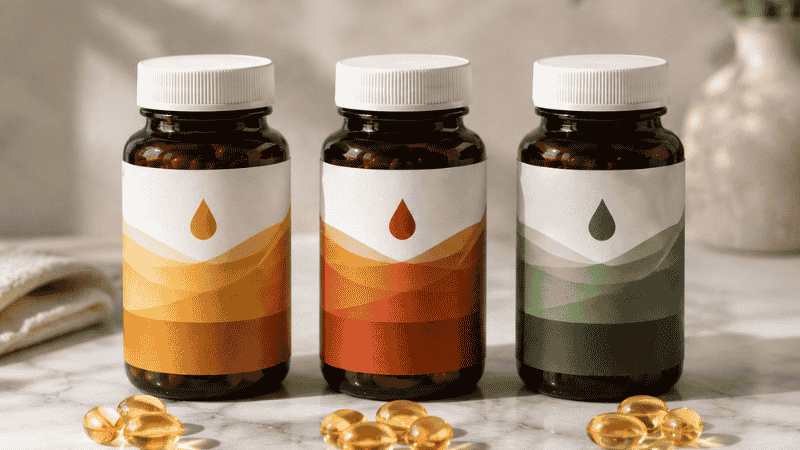
You’re standing in the supplement aisle — or more likely, scrolling through a product page — trying to decide between fish oil, krill oil, and algae oil. The fish oil is cheapest and most familiar. The krill oil claims to be “better absorbed.” The algae oil is marketed as the cleanest, most sustainable option. All three claim to deliver EPA and DHA. The prices range from modest to surprisingly expensive, and none of the labels explain why you’d pick one over another.
Here’s the honest framing: none of these three sources is universally superior. They differ in meaningful ways — molecular form, EPA:DHA ratio, additional compounds, sustainability profile, and price — and those differences make each one the better choice for specific situations. The goal of this guide isn’t to declare a winner; it’s to help you match the source to your situation.
This covers what distinguishes each form, where the science on absorption differences actually stands (it’s more nuanced than most articles suggest), and a clear decision framework for choosing based on your goals, diet, and values.
Key Takeaways
- Fish oil is the most studied, most widely available, and most cost-effective source of EPA and DHA. It’s the default choice for most healthy adults.
- Krill oil provides EPA and DHA in phospholipid form, which may enhance absorption in some studies — though long-term EPA+DHA tissue levels appear comparable to fish oil when matched for dose. Krill oil also contains astaxanthin (KD 16), a natural antioxidant that protects the oil from oxidation.
- Algae oil is the original source — fish accumulate EPA and DHA by eating microalgae. Algae oil provides DHA (and sometimes EPA) that is molecularly identical to fish-derived sources, making it the primary recommendation for vegans and vegetarians.
- The bioavailability debate between fish oil and krill oil is real but often overstated: acute absorption studies show krill oil advantages, but longer-term studies show similar blood-level outcomes when doses are matched.
- Price per mg EPA+DHA: Fish oil is typically 5–10× cheaper than krill oil and 3–5× cheaper than algae oil on a per-milligram basis. If budget matters, fish oil delivers the most omega-3 per dollar.
- Third-party testing (IFOS certification, NSF, USP) is the most important quality indicator regardless of which source you choose.
What Is Krill Oil and How Does It Differ from Fish Oil?
Krill oil comes from Antarctic krill (Euphausia superba) — tiny crustaceans that are among the most abundant animals on Earth by biomass. Like fish oil, krill oil provides both EPA and DHA, but in a different molecular form and with an additional compound that fish oil doesn’t naturally contain.
The phospholipid difference: Most of the EPA and DHA in fish oil is in triglyceride form — the same form as most dietary fats. In krill oil, a significant portion of the EPA and DHA is bound to phospholipids. Phospholipids are amphiphilic (they have both water-attracting and fat-attracting ends), which means they can partially self-emulsify during digestion. This is the basis for claims that krill oil absorbs better.
The astaxanthin advantage: Krill oil contains astaxanthin — a carotenoid pigment that gives krill and flamingos their pink color. Astaxanthin is a potent antioxidant that matters practically for two reasons: it protects the EPA and DHA in the oil from oxidizing during storage (oxidized omega-3s are less effective and potentially counterproductive), and it may have independent health benefits. This is one genuinely distinctive advantage krill oil has over standard fish oil.
The EPA:DHA ratio: Krill oil typically has a higher EPA:DHA ratio than fish oil — roughly 2:1 EPA:DHA in krill oil versus approximately 3:2 in standard fish oil. This makes krill oil somewhat more EPA-dominant, which may be relevant if mood support or anti-inflammatory purposes are the primary goal.
The concentration difference: Krill oil capsules contain substantially less EPA+DHA per gram than fish oil — often 150–200mg combined EPA+DHA per gram of krill oil, versus 300–400mg per gram of standard fish oil. This means you need more capsules to reach the same EPA+DHA intake, which compounds the cost difference.
Krill Oil vs. Fish Oil: What the Absorption Research Actually Shows
This is where intellectual honesty matters, because the marketing around krill oil’s superior absorption is more nuanced than it appears.

The case for krill oil absorption advantage: Several acute (single-dose) pharmacokinetic studies have found that EPA and DHA from krill oil produce higher blood plasma levels in the hours following a dose compared to an equivalent dose of fish oil. The PMC4559234 study found a higher 72-hour incremental area under the curve for krill oil (89.08% × h) versus fish oil (59.15% × h) — a meaningful difference in that acute measurement.
The phospholipid mechanism is plausible: phospholipid-bound omega-3s may integrate into intestinal micelles more efficiently than triglyceride forms, potentially improving absorption rate.
The case for skepticism about the long-term relevance: The critical question is whether acute absorption advantages translate into better long-term tissue EPA+DHA status — and here the evidence is less clear. A randomized, double-blind, four-week study published in Lipids in Health and Disease (2015) found that fish oil and krill oil achieved similar plasma EPA+DHA levels after four weeks of supplementation when compared at equivalent doses. A 2023 study comparing phospholipid-enhanced fish oil to krill oil found similar 24-hour absorption profiles when EPA+DHA content was matched.
Additionally, bioavailability differences between sources are sensitive to whether the supplement is taken with food. Fish oil triglycerides absorb significantly better with a fat-containing meal; krill oil’s phospholipid form absorbs more independently of food. This means studies that don’t control for meal composition may overstate or understate the real-world difference.
The honest summary: Krill oil likely absorbs somewhat faster and may be somewhat more efficient at lower doses. At matched doses over multiple weeks, the difference in tissue EPA+DHA levels appears to be smaller than acute studies suggest. The practical implication: if you choose krill oil primarily for absorption advantages, the benefit is real but may be less dramatic than marketing implies. If you’re taking krill oil for astaxanthin’s antioxidant properties, that’s a genuine and specific reason.
Krill Oil Benefits: What Makes It Worth the Premium
Setting aside the contested absorption debate, krill oil has several specific attributes that make it the better choice in certain contexts:
Astaxanthin content and oil stability: Fish oil oxidizes readily — oxidized fish oil smells rancid, may have reduced efficacy, and potentially produces harmful oxidation products. Astaxanthin in krill oil acts as a built-in antioxidant that significantly extends the oil’s shelf stability. If you’ve ever opened a fish oil bottle and noticed a strong fishy smell, oxidation is likely involved. Krill oil’s natural astaxanthin protection is a practical quality advantage.
Smaller capsule size: Because krill oil may absorb somewhat more efficiently, you may need a smaller physical dose to achieve comparable results — which matters for people who struggle to swallow large capsules or dislike the fishy burp effect associated with fish oil.
Higher EPA relative to DHA: If EPA-predominant omega-3s are your goal (for mood support, anti-inflammatory purposes), krill oil’s naturally higher EPA:DHA ratio aligns better with that target.
Sustainability (with nuance): Antarctic krill are one of the most abundant organisms on Earth, and the fishery is managed under strict international quotas through the Commission for the Conservation of Antarctic Marine Living Resources (CCAMLR). Responsibly sourced krill oil (look for Marine Stewardship Council certification) has a defensible sustainability profile.
The honest tradeoff: All of these advantages come at 3–5× the cost per milligram of EPA+DHA compared to fish oil. Whether that premium is worth it depends on whether you specifically value the astaxanthin, the capsule convenience, or the EPA ratio.
Algae Oil vs. Fish Oil: The Vegan Omega-3 Solution
This is where the origin story of omega-3s becomes practically important.
Fish don’t produce DHA. They accumulate it by eating microalgae — the organisms at the base of the marine food chain that synthesize EPA and DHA from scratch. When you eat salmon or take fish oil, you’re consuming DHA that originated in microalgae, passed up through the food chain. Algae oil goes directly to that original source.

Why this matters: DHA derived from algae (typically from Schizochytrium or Nannochloropsis species) is molecularly identical to DHA from fish or krill. A 2012 study found the bioavailability of DHA from algal oil to be equivalent to that from cooked salmon. Algae oil is not a compromise or a substitute — for DHA specifically, it’s the same molecule, produced more directly.
For vegans and vegetarians: This is the key recommendation. The frequent advice that vegetarians should “just eat more flaxseed” misses a critical point: ALA (the plant-based omega-3 in flaxseed, walnuts, and chia seeds) converts to EPA and DHA in the body at rates below 15% — and to DHA at much lower rates than that. A tablespoon of flaxseed oil contains about 7 grams of ALA, which converts to perhaps 0.5–1 gram of EPA and much less DHA. Algal oil provides DHA (and in some products, EPA) directly, bypassing the limited conversion pathway entirely.
What plant based omega 3 supplement should you choose? For DHA: look for algal oil supplements specifying the DHA content (typically 200–500mg DHA per serving from reputable brands). For EPA: some newer algal oil products derived from Nannochloropsis provide meaningful EPA as well — look for these if EPA is also a goal. For general vegan omega-3 supplementation, an algal oil providing at least 200mg DHA daily is a reasonable starting point.
Sustainability: Algae oil is farmed in controlled conditions — no ocean harvesting, no bycatch, no marine ecosystem impact. For people who prioritize environmental considerations, algal oil is the most defensible choice by a significant margin.
The tradeoff: Algal oil supplements are typically more expensive per milligram than fish oil, and the product selection is narrower. EPA-containing algal oils are less commonly available than DHA-only versions. For non-vegans, fish oil provides more EPA+DHA per dollar.
The Three-Way Decision Framework: Who Should Choose What
Rather than ranking these sources, here’s a practical framework based on your situation:
Choose Fish Oil If:
- You’re a healthy adult supplementing for general EPA+DHA intake
- Cost efficiency is important — you need more omega-3 per dollar
- You can reliably take it with a fat-containing meal (which significantly improves absorption)
- You’re already taking an antioxidant supplement or eating antioxidant-rich foods that reduce oxidation concerns
- You want the most extensively studied, most widely available form
What to look for: IFOS (International Fish Oil Standards) certification or equivalent third-party testing. Look for the EPA and DHA content specifically in the Supplement Facts panel. Natural triglyceride or re-esterified triglyceride forms absorb better than ethyl ester forms — check the label if this information is provided.
Choose Krill Oil If:
- You want built-in oxidation protection from astaxanthin without taking a separate antioxidant
- You prefer smaller capsules and don’t want to take multiple large softgels
- EPA is your primary target (mood support, anti-inflammatory purposes) and you want a naturally EPA-dominant ratio
- You’re willing to pay a premium for these specific advantages
- You’ve had consistent fishy burp problems with fish oil that haven’t resolved with enteric coating
What to look for: Marine Stewardship Council (MSC) certification for sustainability. Confirmed astaxanthin content on the label. Total EPA+DHA per serving — remember that krill oil capsules are typically lower concentration than fish oil.
Choose Algae Oil If:
- You’re vegan or vegetarian
- You don’t eat fish for any reason (preference, allergy, sustainability concerns)
- You want to avoid any concern about marine food chain contaminants
- Sustainability and environmental impact are important to you
- You specifically need DHA during pregnancy and don’t consume fish
What to look for: Algae species specified on the label (Schizochytrium and Nannochloropsis are the most common). DHA content clearly stated. EPA content if that’s also a goal (not all algal oils contain meaningful EPA). Third-party testing for purity.
Omega-3 Supplement Quality: What Matters Regardless of Source
The source is one decision. Quality within that source category is another — and arguably equally important.
Oxidation is the primary quality concern for all fish-derived oils. Oxidized omega-3s smell strongly rancid, taste unpleasant, and may have reduced efficacy. Fresh fish oil should smell mildly oceanic, not aggressively “fishy.” If your supplement smells strongly upon opening, it may be oxidized. Storing in the refrigerator after opening significantly extends stability for all three sources.
Third-party certification: Look for IFOS (International Fish Oil Standards) certification for fish and krill oil — this tests for EPA+DHA content accuracy, oxidation levels, and contamination (mercury, PCBs, dioxins). NSF International and USP provide similar verification. Algal oil benefits from similar third-party testing for potency and purity.
Heavy metals: Fish oil supplements go through molecular distillation that removes mercury and other heavy metals. Despite what some people believe, reputable fish oil supplements are generally free of detectable mercury — they’re actually safer in this regard than whole fish, which accumulates mercury in its tissue. Algae oil, farmed in controlled conditions, has no heavy metal concern.
Ethyl ester vs. triglyceride form: This applies primarily to fish oil. Many concentrated fish oil supplements use ethyl ester form (created through molecular distillation), which has lower bioavailability — particularly without dietary fat. Re-esterified triglyceride and natural triglyceride forms absorb better. If this information is provided on the label, prefer triglyceride forms.
Safety Considerations for All Three Sources
All three omega-3 sources are generally safe at recommended doses for most healthy adults. Specific considerations:
Blood-thinning effects: EPA and DHA have mild antiplatelet effects. At typical OTC doses (1–3g/day total fish oil), this is not clinically significant for most people. At higher doses (4g+), or if you’re on anticoagulant medications (warfarin, aspirin therapy, clopidogrel), discuss with your doctor before supplementing.
Shellfish allergy and krill oil: Krill are crustaceans — in the same family as shrimp, crab, and lobster. If you have a shellfish allergy, discuss krill oil with your allergist before taking it. Fish oil and algae oil are appropriate alternatives.
Surgery: Standard guidance recommends stopping high-dose fish oil supplementation 1–2 weeks before scheduled surgery due to mild blood-thinning effects. Discuss with your surgeon.
Pregnancy: All three sources can be appropriate during pregnancy for DHA support. Algal oil is often recommended because it provides DHA without concerns about mercury or other marine contaminants, though high-quality fish oil supplements are also considered safe. Discuss with your prenatal care provider.

Frequently Asked Questions
Is krill oil better than fish oil? Not universally — it depends on what you’re optimizing for. Krill oil has genuine advantages: built-in antioxidant protection from astaxanthin, a phospholipid form that may enhance acute absorption, and a naturally EPA-dominant ratio. Fish oil has its own advantages: significantly lower cost per milligram of EPA+DHA, more extensive clinical research, and wider product availability. Long-term EPA+DHA tissue levels appear comparable between matched doses of each.
What is the best omega-3 supplement? The best source depends on your situation: fish oil for most people (cost-effective, well-studied); krill oil for those willing to pay a premium for astaxanthin protection and potentially better single-dose absorption; algae oil for vegans, vegetarians, and anyone avoiding fish-derived products. Within each category, third-party certified products (IFOS, NSF, USP) are the quality standard.
Is algae oil as good as fish oil for omega-3? For DHA specifically, yes — the DHA in algae oil is molecularly identical to fish-derived DHA, and bioavailability has been shown to be equivalent to cooked salmon. For EPA, algal oils vary — some newer products provide meaningful EPA, others are primarily DHA. For vegan omega-3 supplementation, algae oil is the direct solution that bypasses the limited ALA-to-DHA conversion in plant-based diets.
Does fish oil or krill oil absorb better? Acute pharmacokinetic studies show krill oil absorbs somewhat faster. Longer-term studies (4+ weeks) show similar plasma EPA+DHA levels when doses are matched. The practical significance of the absorption difference depends on whether you take fish oil with food (which significantly improves triglyceride absorption) and what dose you’re taking.
Is krill oil safe for people with shellfish allergies? Krill are crustaceans, related to shrimp and lobster. If you have a diagnosed shellfish allergy, consult your allergist before taking krill oil. Fish oil and algae oil are safe alternatives that don’t carry this concern.
What’s the most sustainable omega-3 supplement? Algae oil has the best environmental profile — farmed in controlled conditions with no ocean ecosystem impact. Krill oil from MSC-certified sources has a defensible sustainability record given krill’s massive biomass and regulated fishery. Fish oil sustainability varies significantly by species and source — look for MSC certification and sourcing from non-overfished species.
The Bottom Line
Krill oil vs. fish oil vs. algae oil — the answer isn’t which is best. It’s which is best for your situation.
Fish oil is the rational default for most people: well-studied, affordable, and effective when taken with food. Krill oil earns its premium specifically through astaxanthin protection and convenient smaller doses, not through dramatic absorption superiority. Algae oil is not a compromise for vegans — it’s the same DHA molecule, from the original source, appropriate for anyone who avoids fish.
Whatever you choose, the more important decisions are: ensuring the product is third-party tested, checking the specific EPA and DHA amounts on the label (not just the total oil weight), and taking it consistently with food.
Want to understand whether you need more EPA or DHA — and how to read your supplement label to find the right ratio? EPA vs. DHA: What’s the Difference and Which One Do You Actually Need? (C3)
Not sure if you’re getting enough omega-3 overall? Omega-3 Deficiency Symptoms: Signs Your Body May Not Be Getting Enough (C1)
References
- Köhler A, Sarkkinen E, Tapola N, Niskanen T, Bruheim I. Bioavailability of fatty acids from krill oil, krill meal and fish oil in healthy subjects — a randomized, single-dose, cross-over trial. Lipids in Health and Disease. 2015;14:19. doi:10.1186/s12944-015-0015-4
- Yurko-Mauro K, Kralovec J, Bailey-Hall E, Smeberg V, Stark JG, Salem N Jr. Similar eicosapentaenoic acid and docosahexaenoic acid plasma levels achieved with fish oil or krill oil in a randomized double-blind four-week bioavailability study. Lipids in Health and Disease. 2015;14:99. doi:10.1186/s12944-015-0109-z
- National Institutes of Health Office of Dietary Supplements. Omega-3 Fatty Acids: Fact Sheet for Health Professionals. Updated May 2026. https://ods.od.nih.gov/factsheets/Omega3FattyAcids-HealthProfessional/
- Arterburn LM, Oken HA, Bailey Hall E, Hamersley J, Kuratko CN, Hoffman JP. Algal-oil capsules and cooked salmon: nutritionally equivalent sources of docosahexaenoic acid. Journal of the American Dietetic Association. 2008;108(7):1204-1209. doi:10.1016/j.jada.2008.04.021
- Calder PC. Omega-3 fatty acids and inflammatory processes: from molecules to man. Biochemical Society Transactions. 2017;45(5):1105-1115. doi:10.1042/BST20160474